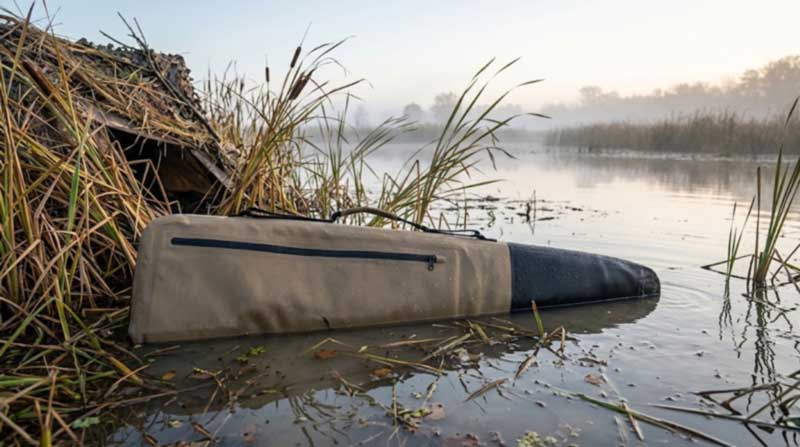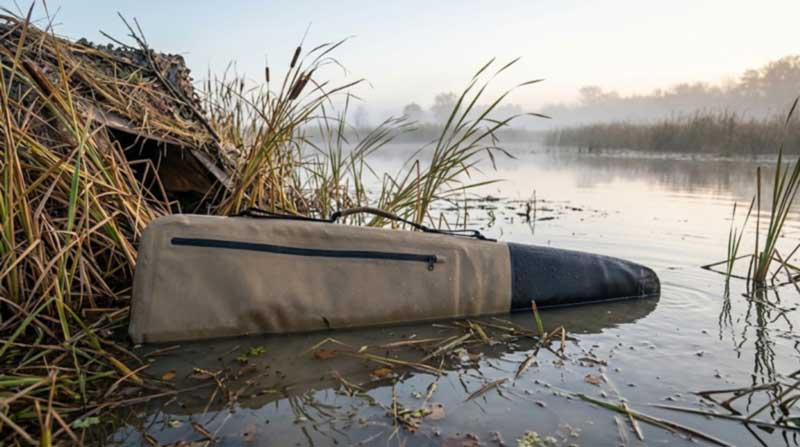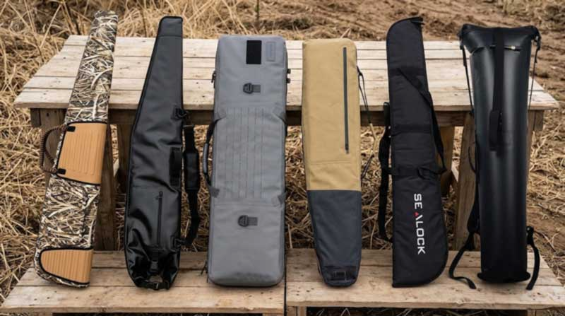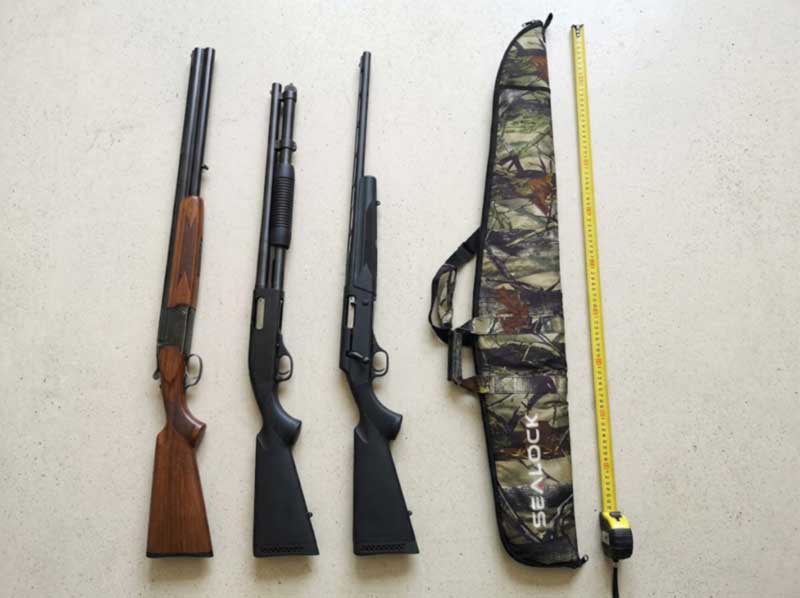
Most gun cases sold as waterproof are water-resistant. The difference rarely shows in a shop or on a dry drive to the range. It shows the first time a case lies in a flooded blind, rides in the bottom of a duck boat, or goes over the side and has to be fished out. At that point the case either has a sealed shell and a sealed closure, or it has a coated fabric that lets water in at the seams.
This guide follows the routes water takes into a gun case, explains which constructions close each one, and shows how a buyer can check a "waterproof" claim before trusting it with a firearm. It also covers what a waterproof case cannot do. The most important of those limits concerns the gun itself.
No. Firearms are made to work in rain, and most will still fire after getting wet, but water does not stay outside them. It runs into the action, the trigger group and the bore, it gets under the stock where the wood or synthetic meets the metal, and it stays in the gaps between parts. Carbon steel starts to corrode as soon as it is wet and exposed to air. Salt water and marsh water, which carry salts and organic acids, make it corrode faster. Even stainless steel and coated finishes have exposed springs, pins and screws.
That is why the case matters. A shotgun that comes out of a dry case at the blind gets wet only from the rain, and gets wiped down at the end of the day. A shotgun that has spent an hour in a case full of marsh water needs to be stripped, dried and oiled before the truck leaves the launch.
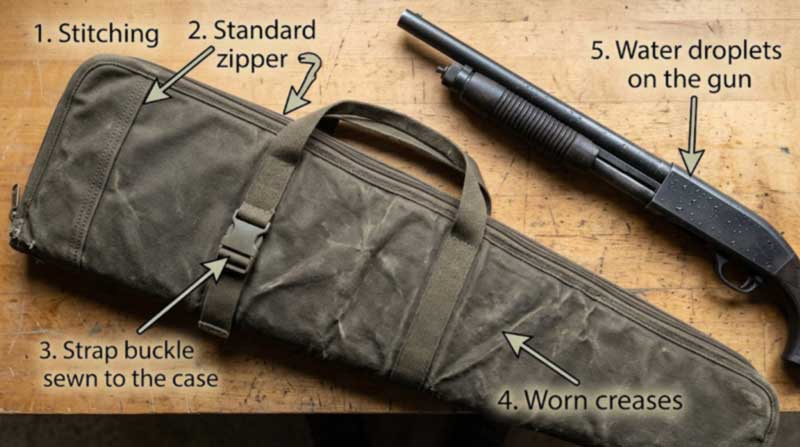
A gun case can let water in at five points. A waterproof case has to close all five. Most water-resistant cases close one or two.
1. Through the seams. Every stitch puts a needle hole through the shell. Seam tape and coatings slow the water down, but under pressure, from immersion or from a case lying in a puddle with a gun's weight on it, water follows the thread through each hole. This is the most common failure, and it is why stitched construction cannot be truly waterproof, whatever fabric it uses.
2. Through the closure. A standard coil or moulded zipper has gaps between its teeth by design. Even when it is fully closed, water passes straight through it. A storm flap over the zipper helps in rain but does nothing once the case is in water.
3. Through attachments. Handles, strap anchors, D-rings and MOLLE webbing are usually sewn through the shell. On a welded case, each one of these puts back the needle holes the welding was meant to remove. On cheaper "waterproof" cases, this is where they quietly leak.
4. Through the fabric itself. A coated fabric is only as waterproof as its coating. Abrasion, folding at the same crease, cold cracking in PVC, and pinholes in a thin coating all open small leaks over time. A laminated fabric, which has a continuous TPU film bonded to the cloth, holds up much better than a sprayed or knife-over-roll coating.
5. With the gun. Water that comes in on a wet gun, or condenses inside a sealed case when a cold gun meets warm, humid air, has nowhere to go. A fully waterproof case keeps it in as well as it keeps the marsh out. This route is covered in more detail below, because no construction closes it.
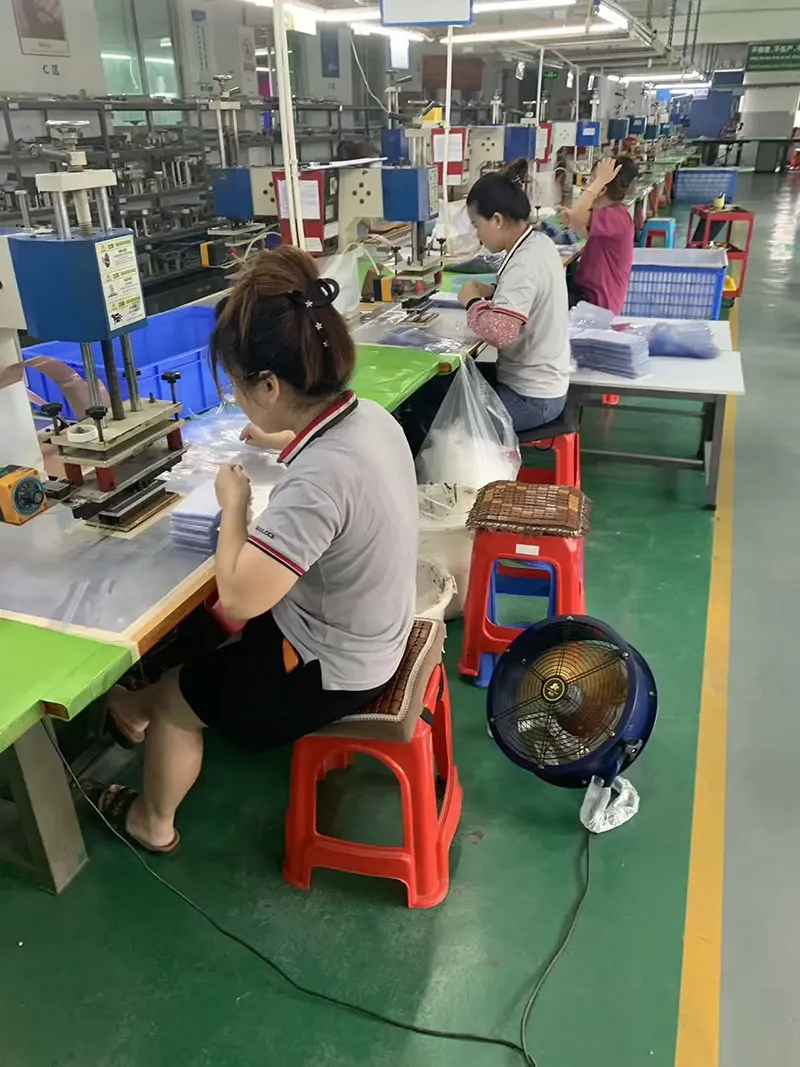
A waterproof gun case starts with TPU-laminated fabric joined by high-frequency welding. Radio-frequency energy heats the TPU film on two overlapping layers until they melt together under pressure, so the seam becomes one continuous band of material with no holes. A good weld is stronger than the fabric beside it. When a properly welded seam is pulled to destruction in a tensile test, the fabric next to the seam tears first.
Weld quality depends on settings, not just on the machine: power, pressure, time and the shape of the die all have to suit the fabric weight and the print. Printed camouflage, for example, behaves slightly differently in the die from plain fabric. Sealock's welding settings come from more than two decades of dry-bag production, which is why the same seam widths and test routines carry over to gun cases.
There are two ways to seal the opening, and each has a cost.
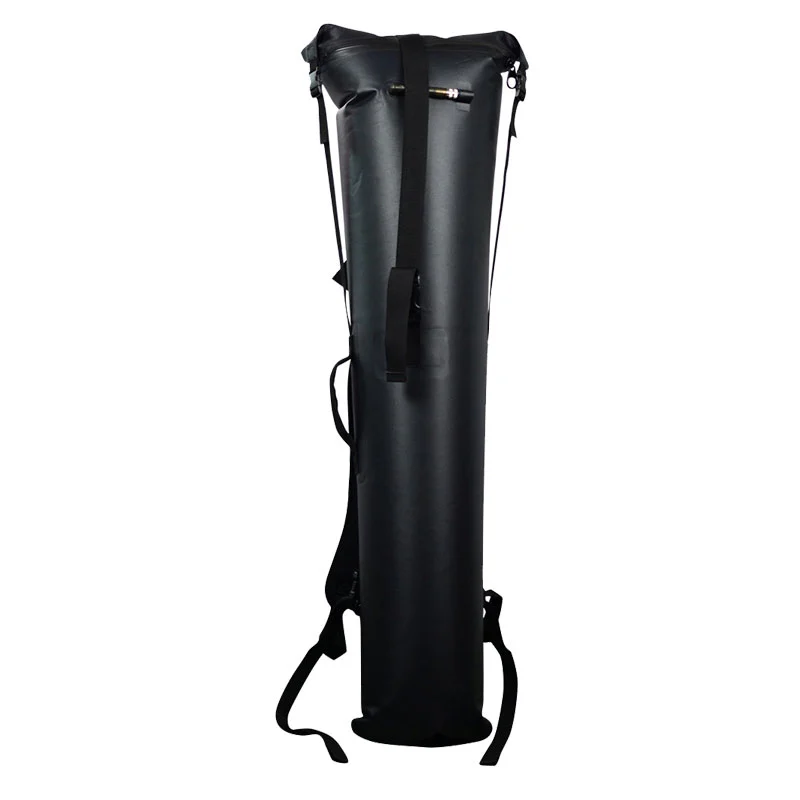
A roll-top closure works like a dry bag. The mouth is folded over itself at least three times and buckled, which leaves water no straight path in. It has no moving parts to clog with mud, sand or ice, and it is the more forgiving closure for hunters who are hard on their gear. The cost is length and speed: the roll takes up material, so the case is longer than the gun it carries, and opening it takes both hands and a few seconds. Sealock's SL-P857 uses a three-fold roll-top on a one-piece welded 840D TPU body rated IPX7. It is 155 cm flat and 137 cm sealed, so the roll takes 18 cm, about 12% of the flat length.
An airtight zipper uses interlocking teeth on a rubberised or TPU tape that seal against each other when fully closed. It opens fast with one hand, which matters when birds are working. The cost is care. Sand and dried mud in the track are what wear the seal and make the slider stick, and a hunter who forces a stiff zipper soon has one that no longer seals. The makers of these zippers recommend cleaning them with mild soap and water and lubricating the slider and outer coating, while keeping lubricant off the teeth, where it collects grit. The SL-E603 marsh case sets its waterproof zipper directly into the welded body seam, rated IPX7, and can be ordered with an enlarged pull so a gloved hand does not need to force it.
A sealed shell and a sealed closure are wasted if the strap anchors are sewn through the body. On a properly built waterproof case, D-rings and handles sit on welded tabs, and any webbing or load-carrying system is mounted on a separate welded panel. The SL-C811 is a good example. Its MOLLE grid is laser-cut into a welded outer panel rather than sewn on as rows of webbing, so the case carries pouches and still holds an IPX6 rating.
None of these words is regulated on a gun case, so the useful questions are how the case is built and what it was tested to.
| What the label says | What it usually means | Will it survive immersion? |
|---|---|---|
| Weather-resistant | Coated fabric, stitched seams, standard zipper | No. Sheds light rain only |
| Water-resistant | Coated fabric, stitched seams, sometimes a water-resistant or "waterproof" zipper | No. Handles rain, dew, splashes and wet ground for a while |
| Waterproof, rated IPX6 | Welded shell, sealed closure; tested against powerful water jets | Not rated for it. Handles storms and boat spray |
| Waterproof, rated IPX7 | Welded shell, sealed closure; tested for temporary immersion | Yes. Rated for one metre for 30 minutes under IEC 60529 |
| "Waterproof" with no rating or test stated | Anything from a fully welded case to coated nylon | Unknown until you test it |
One detail catches out a lot of buyers. A case can have a waterproof zipper and still not be a waterproof case. Sealock's SL-P1076 padded rifle case uses a heavy-duty waterproof zipper with lockable pulls, but its 600D Oxford body is stitched, so the case as a whole is water-resistant and carries no IPX rating. That is the honest description, and it is the one printed on the page. A zipper seals one of the five entry points, not all of them.
Sealock tests IPX6 models with a heavy rain and water-jet test, and IPX7 models with a full water-immersion test lasting two hours or more, four times the standard's 30 minutes.
It depends on whether the case could end up under water.
For a hunter who stays on land in heavy weather, such as an elk hunter in a week of rain, a sheep hunter in sleet, or someone walking into a stand through wet brush, an IPX6 case is enough. Water arrives from above and from the side. It does not surround the case. An IPX6 build can also carry real padding and external load carriage, as the SL-C811 does with 20–25 mm of EVA foam and a backpack harness, without the compromises that full submersion requires.
For a waterfowler in a boat, a kayak hunter, anyone wading flooded timber, or anyone who sets the case down in a marsh, IPX7 is the floor. These are the situations where a case actually ends up in the water, and a jet rating says nothing about how a case behaves when submerged.
Floating is a separate question, and the rating does not answer it. A sealed IPX7 case with air inside will often float when empty. Whether it stays up with a shotgun inside depends on how much buoyancy the case has against the weight of the gun. Cases built specifically to float usually include closed-cell foam for that purpose. If flotation matters, ask what load the case was tested to float, and treat a floating claim with no stated load as unproven.
The cheapest waterproof gun cases are unpadded: a welded sleeve and a closure, essentially a long dry bag. They keep water out and very little else. A gun in an unpadded sleeve that slides off a tailgate takes the impact almost directly.
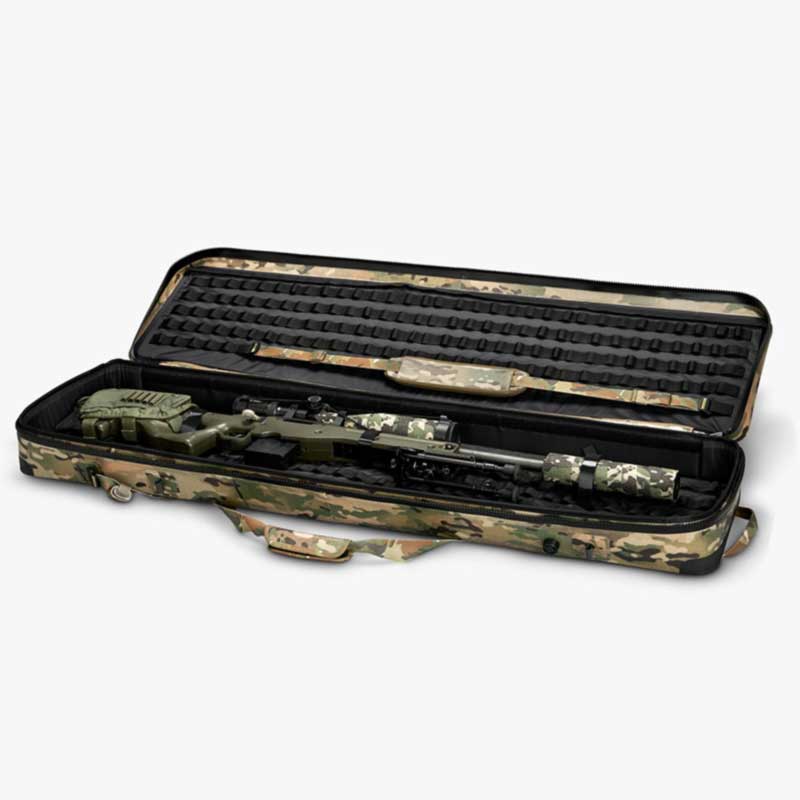
Adding padding inside a welded shell is harder than it looks. Foam cannot be quilted to the shell the usual way, because that would mean stitching through it. Instead, the foam is either loose inside the welded body, sealed inside its own welded pocket, or held by welded retention points. Closed-cell foams such as EVA and PE are the right choice. They do not soak up water if some gets in, and they add buoyancy. Open-cell foam inside a waterproof case gives you the worst of both: it holds any water that gets in or comes in on the gun, and the case has nowhere to let it out.
A case that keeps water out also keeps water in. This is the fifth entry point, and the one buyers most often overlook.
A gun that goes into a sealed case wet stays wet. A cold gun brought from the blind into a heated truck cab or a warm house draws moisture out of the air inside the case, and that condensation forms on the metal. Seal it and leave it, and the next time the case is opened there is surface rust on the receiver, sometimes after only a day or two.
The routine is simple, and it should be on the care card that ships with every waterproof case. Wipe the gun and the inside of the case before you close it after a wet hunt. Open the case as soon as you get home and leave the gun out to dry and reach room temperature. Rinse a case that has been in salt or marsh water with fresh water and let it dry open, with the zipper or roll-top unfastened. Don't use a sealed waterproof case for storage between seasons. A gun cabinet with controlled humidity, or a breathable sleeve, is the right place for that.
A buyer does not need a lab to check a waterproof case. Two simple tests will catch most problems.
The squeeze test (welded cases only). Seal the empty case with air inside and press down on it slowly with both hands. A sound welded case holds its shape and stays firm. If you hear a hiss or the case slowly goes soft, there is a leak at a seam, a weld or the closure. Run your hand over the seams while pressing to find it.
The towel test. Line the empty case with dry paper towels, seal it, and hold it under water in a bathtub or tank with a weight on top for 30 minutes. Then open it and check the towels. Wet patches show where water got in. This does not reproduce one metre of depth, but it shows up bad seams, poorly sealed closures and sewn-through attachments straight away.
The factory version of the squeeze test is more demanding. At Sealock, welded cases go through unboxing, vacuum extraction, a 24-hour static rest, and then the air-leak check. A case that has drawn air back in overnight has a leak, and it does not ship. Buyers running their own incoming inspection can use the same procedure.
Rifle rain covers and scope covers solve a different problem. A rain cover is a light shroud that keeps water off the action and the optic while the rifle is slung or on a rest, so it can still be raised and fired in seconds. It is a field accessory, not a transport case, and it offers no impact protection. Many hunters carry both: the cover for the hunt, and a case for getting there and back. When a case is specified for wet conditions, check that the scoped rifle actually fits with its covers on, because flip-up covers add height at the objective and eyepiece.
A brand writing a waterproof gun case specification should fix four things before asking for a quote: the firearm list, with overall length and height at the optic; the rating it is prepared to print, IPX6 or IPX7; the closure; and whether the case must carry padding or external load. Those four decisions set the material, the welding moulds and the test method. Everything else, including colour, camouflage, logo and packaging, can be adjusted later.
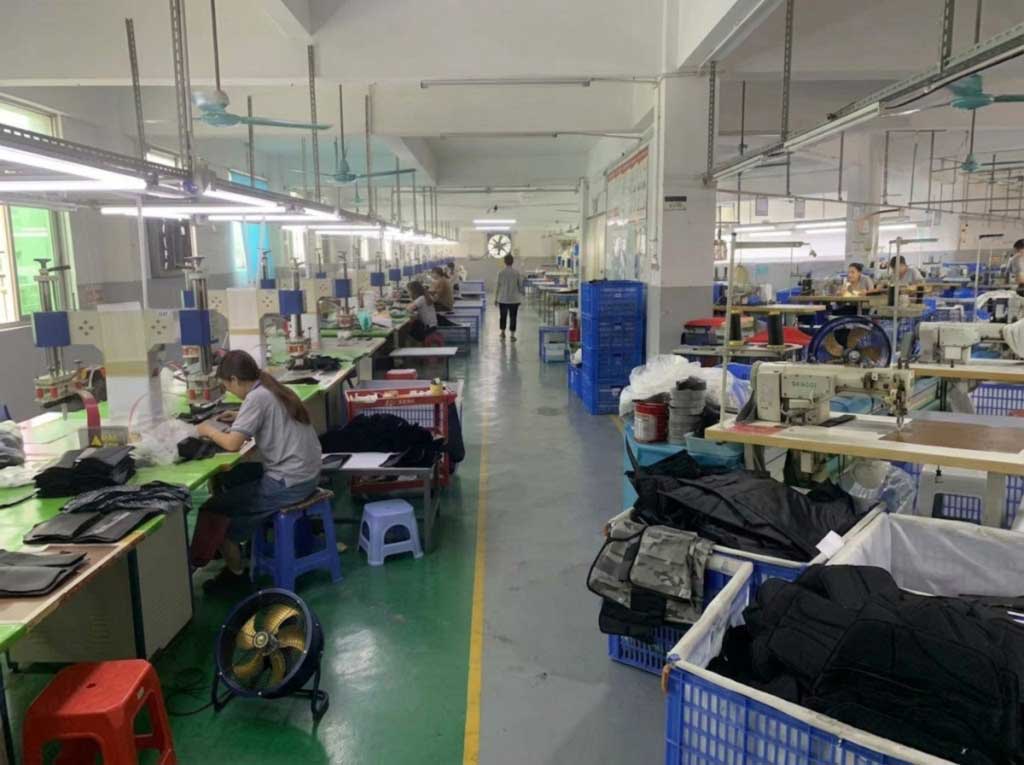
At Sealock, welded and stitched production both run in-house in Dongguan and Ho Chi Minh City. Samples are typically ready in 7–15 days from a confirmed specification, and production takes 30–45 days. Minimum orders are 300–500 pieces per model depending on construction, with colours and logos adjustable within the order. Projects that need new welding moulds take longer than changes to an existing model, and we plan that in from the first quote. Every waterproof model is immersion- or jet-tested to its rating, and SGS or QIMA third-party inspection is available on request.
For the wider picture of how waterproof cases compare with padded cases, blind bags and other hunting bags, see Hunting Bags Explained: Types, Materials and What Each One Is Built to Carry.
The seam was almost certainly stitched rather than welded, or a strap anchor was sewn through near it. Coated fabrics with stitched seams resist rain but let water through the needle holes once the case sits in water with weight on it. A welded seam has no holes to leak through.
Yes, but only if the shell is welded and the padding is installed without stitching through it. Closed-cell foam such as EVA or PE is the right padding for a waterproof case, because it does not soak up water and adds some buoyancy.
A roll-top is more forgiving and tolerates mud and sand better, but it adds length and is slower to open. A waterproof zipper is faster and can be worked with one hand, but it needs regular cleaning and lubrication to keep sealing. For boat and marsh work where speed matters, choose the zipper and look after it. For rough use and long storage, choose the roll-top.
It can, if it goes in wet or cold and the case is left sealed. The case keeps that moisture in. Dry the gun and the inside of the case after a wet hunt, open the case as soon as you get home, and don't use a sealed case for storage between seasons.
Not reliably with a gun inside, unless it was built and tested to float. A sealed empty case often floats. A loaded one depends on its buoyancy compared with the weight of the gun. Ask for the test load before relying on flotation.
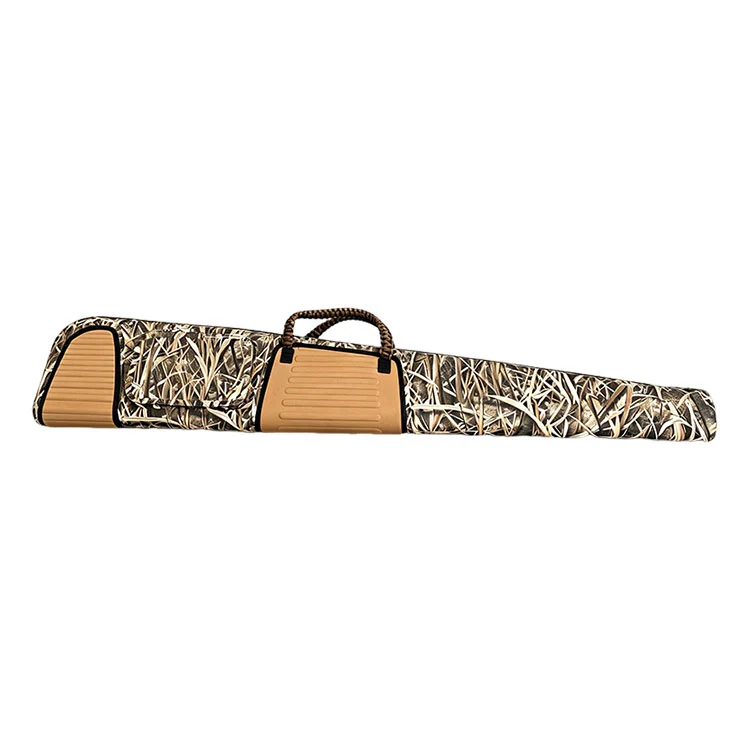
Minimum orders are 300–500 pieces per model. Logos can be screen-printed, heat-transferred or applied as rubber patches. Camouflage can be printed on the TPU laminate before welding, and pattern scale should be approved on a sample. Pricing depends mainly on the rating, the closure, padding and order quantity, so send the firearm list and the rating you need for an accurate quote.
Browse the waterproof floating hunting bags range, or send your firearm list, target rating and market to info@sealock.com.hk or through the contact page. We will recommend a construction and closure, quote material options, and set out a sample plan.