Products
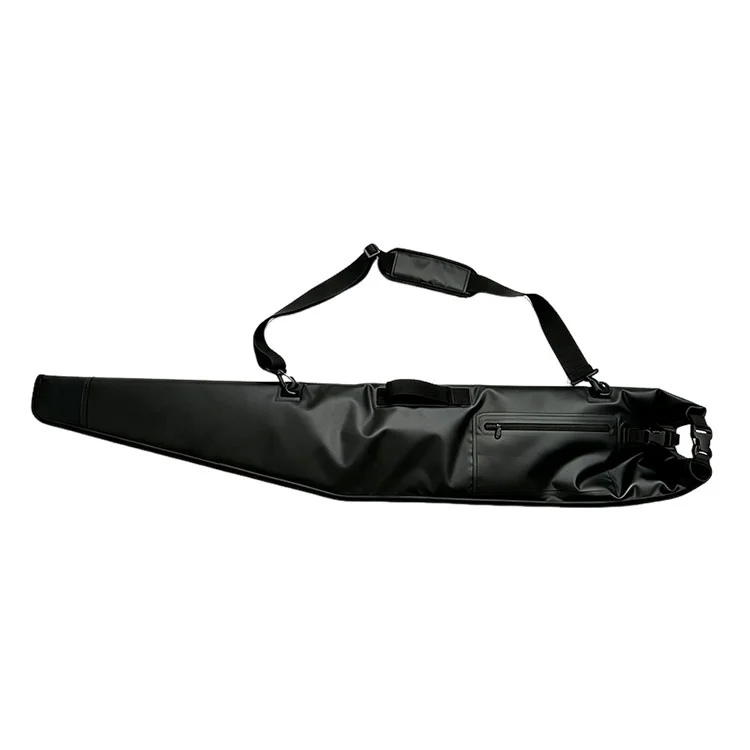
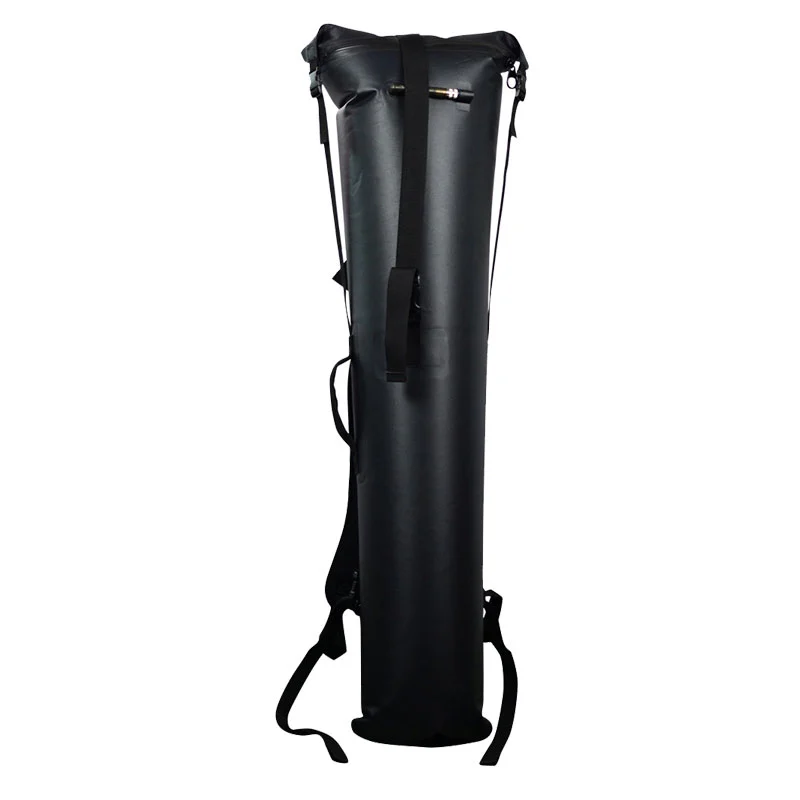
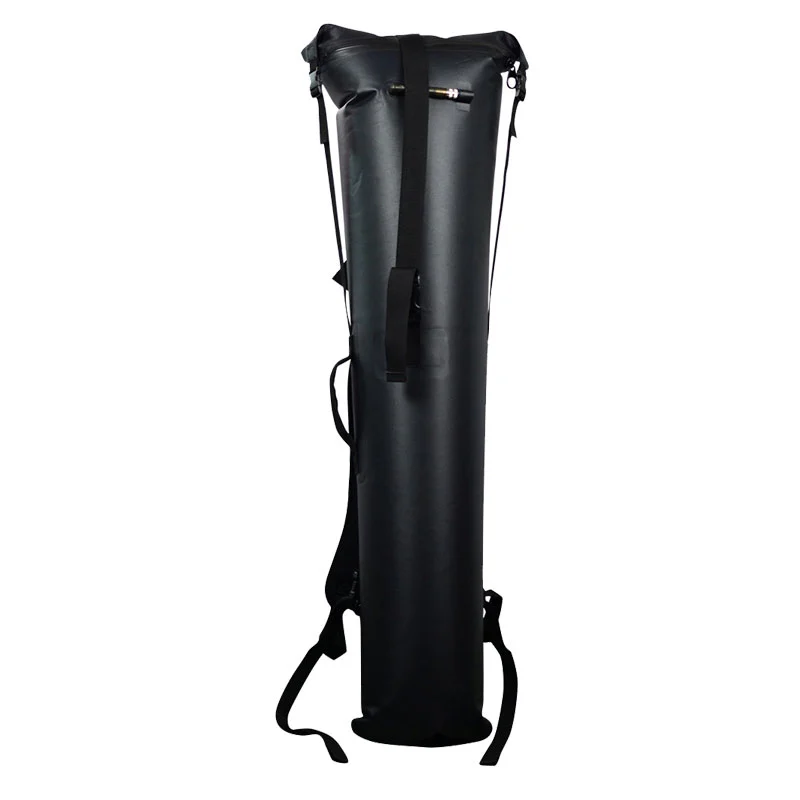
Tubular Waterproof Gun Case
  • Tubular Waterproof Gun CaseTubular Waterproof Gun Case

Tubular Waterproof Gun Case

A 25 cm circular section encloses 491 cm² — 2.17 times the volume of a flat gun case over the same 130 cm length, for 14% more fabric. Distributors comparing price lists on a tubular waterproof gun case can place bulk orders factory-direct with Sealock, a welded-case producer supplying from China and Vietnam. 60 L, 1.35 kg, IPX7, MOQ 300 pcs.

A gun case cut to the silhouette of a firearm looks purposeful. A tube does not, and it outperforms the contoured shape on three measurable counts: enclosed volume per unit of fabric, how the body carries external load, and how quickly a firearm can be put into it.

Tubular Waterproof Gun CaseCylindrical body construction and cross-section comparison with a flat gun case
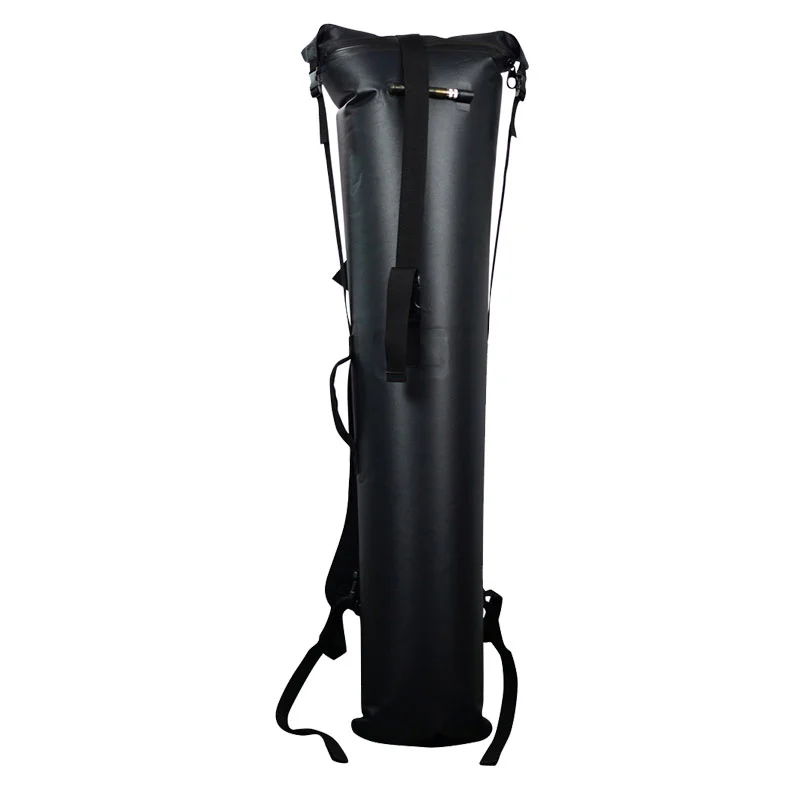
Geometry and Figures

Specification Value
Model SL-E302
Cross-Section Circular, 25 cm diameter
Cross-Sectional Area 491 cm²
Body Length 130 cm
Enclosed Volume 63.8 L theoretical / 60 L usable
Net Weight 1.35 kg ± 0.15 kg
Shell 840D TPU laminated, RF welded
Waterproof Rating IPX7 — immersion to 1 m for 30 minutes
MOQ / Sampling / Production 300 pcs / 7–10 days / 30–45 days

Cross-Section: Volume Per Unit of Fabric

A circle encloses more area for a given perimeter than any other shape. Applied to a gun case, the perimeter is the width of fabric consumed and the area is the volume available inside.

Measurement SL-E302 Circular Typical Flat Case (30 × 8 cm)
Cross-sectional area 491 cm² 226 cm²
Perimeter (fabric width used) 78.5 cm 69.1 cm
Enclosed area per cm of perimeter 6.25 cm² 3.27 cm²
Volume over a 130 cm length 63.8 L 29.4 L
Volume ratio 2.17 × 1 ×

For 14% more fabric across the perimeter, the circular section encloses 2.17 times the volume. Measured per centimetre of fabric consumed, the tube is 1.9 times more efficient — which is why a 60 L case weighs 1.35 kg rather than the mass a flat case of equivalent capacity would require.

How a Tube Carries External Load

Gear stacked in a truck bed, a case wedged under a boat bench, and a pack compressed against a bulkhead all apply the same kind of external pressure.

A flat panel under pressure works in bending. The load concentrates at the centre of the panel and at the folded edges, and both are the points where a flat case dents, creases permanently, or splits along a seam. A circular section under pressure distributes the same load as tension around its circumference, with no single point carrying a concentration.

Loading Behaviour Circular Section Flat Section
Force distribution Tension around the full circumference Bending concentrated at panel centre and edges
Crease formation No fixed fold line; contact point rotates Creases at the same edges every time
Fatigue over repeated loading Distributed; no repeated stress point Accumulates at fixed crease lines
Glancing impact Curved surface deflects Flat face absorbs squarely
Torsional stiffness along the length High — closed circular section Low — flat section twists

Torsional stiffness is the property most often overlooked. A closed circular section resists twisting along its length far better than a flat one, which is what keeps a 130 cm case from wringing itself around a firearm when it is lashed to a moving vehicle.

Loading Without Alignment

A contoured case has one correct orientation. The stock, receiver, and barrel each have to land in their intended section, which requires the user to identify the correct rotation before inserting the firearm.

A circular section has no correct orientation — the cross-section is identical at every angle around the axis. The firearm goes in whichever way it happens to be held, through a mouth that opens to a full 39 cm flattened width.

• No rotational alignment required, in the dark or with cold hands

• Full-width top opening rather than a tapered mouth

• Accepts varied firearm profiles without a dedicated internal shape

• Scoped rifles, bipods, and extended magazines clear the opening without being threaded past a contour

• Same procedure regardless of which firearm from a fleet is being cased

Interior Clearance

The 25 cm internal diameter is uniform along the full 130 cm length, so the clearance available at the receiver is the same as at the muzzle.

Item Clearance Consideration
Bolt-action rifle with scope Uniform 25 cm diameter clears optic and mount without a dedicated recess
Rifle with bipod attached Folded bipod clears within the section; confirm at sampling for wide models
Shotgun with extended magazine No taper at the muzzle end to restrict a magazine tube
Mixed fleet One internal profile serves every firearm in a rental or club fleet
Accessories alongside the firearm Remaining volume within the 60 L capacity takes ammunition, cleaning kit, or optics case

A contoured case narrows toward the muzzle, which is where extended magazine tubes and long barrels run out of room. The tube does not narrow.

Welded Tubular Shell

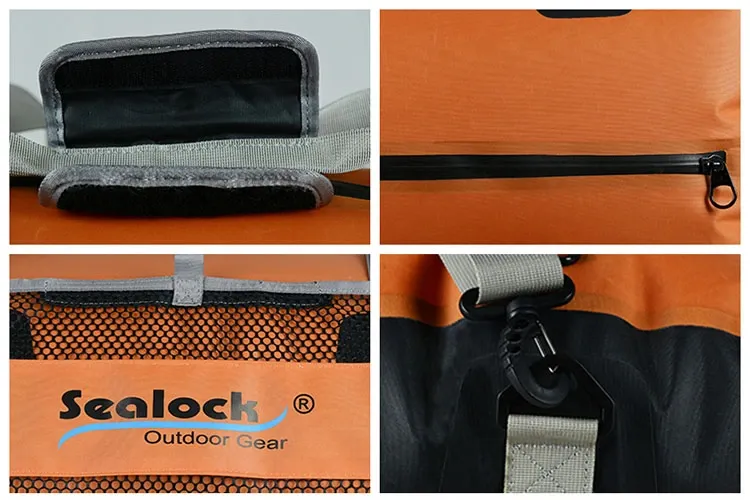
A tube is formed with a minimal seam layout — fewer joins than the multiple shaped panels a contoured case requires. The body is cut from 840D TPU-laminated fabric and closed with RF welded seams, leaving no stitch perforations anywhere in the waterproof shell and no seam ridges pressing against the firearm inside.

• Minimal seam count compared with multi-panel contoured construction

• Reinforced circular welded base takes ground and deck abrasion

• Carry points on welded reinforcement patches rather than sewn through the shell

• Smooth interior with no seam ridges or exposed stitching

Specification

Product Data

Item Specification
Model Number SL-E302
Product Name Tubular Waterproof Gun Case
Body Geometry Cylindrical, uniform circular cross-section
Internal Diameter 25 cm
Cross-Sectional Area 491 cm²
Body Length 130 cm
Usable Capacity 60 L
Net Weight 1.35 kg ± 0.15 kg
Shell Material 840D TPU laminated (500D PVC / 420D TPU optional)
Seam Construction RF welded
Closure Roll-top, three folds, POM side-release buckles
Waterproof Rating IPX7 — immersion to 1 m for 30 minutes
Max Firearm Length 50 in (127 cm)
Empty-State Storage Rolls flat
OEM / ODM Supported

Materials

Component Material Function
Tube Shell 840D TPU Laminated Waterproof barrier; abrasion resistant; weldable
Seams RF Welded Minimal seam count; no stitch perforations
Base Reinforced Circular Welded Base Ground and deck abrasion at the standing end
Reinforcement Welded Patch Carry load transferred without piercing the shell
Buckles POM Side-Release Corrosion-free closure hardware
Webbing Heavy-Duty Nylon Carry, compression, and lashing points

Dimensional Options

Option Available Notes
Tube Diameter ✔ Adjusts internal clearance for optics and accessories
Tube Length ✔ Matched to target firearm range
Shell Material ✔ 840D TPU / 500D PVC / 420D TPU
Logo Printing / Welded Patch ✔ Applied without piercing the shell
Pantone Colour Matching ✔ Confirmed at sampling
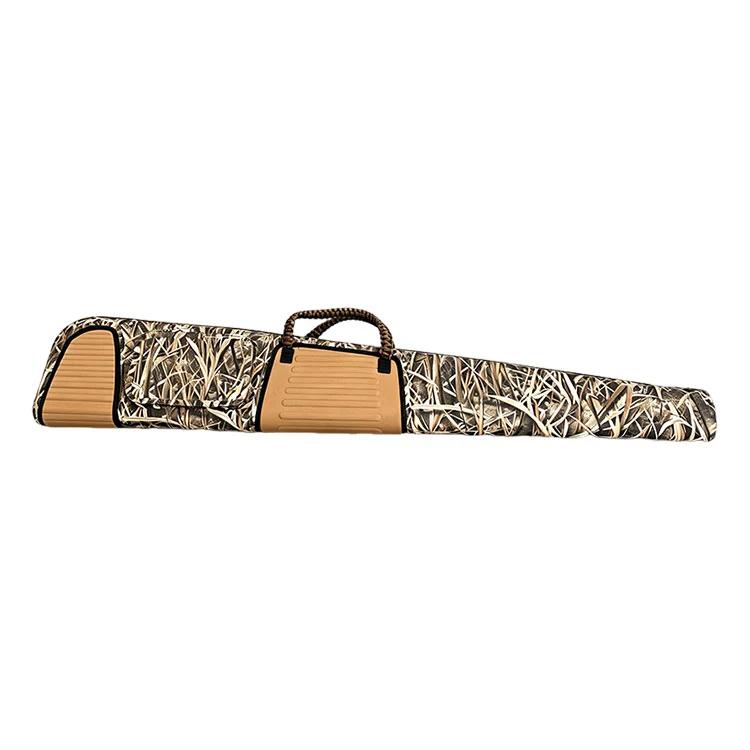
Camouflage Pattern ✔ Marsh, timber, or customer pattern
Lashing Point Configuration ✔ For vehicle, boat, or pack attachment
Packaging / Private Label ✔ Colour box, printed carton, hang tag

Where the Shape Pays Off

The tubular format is specified where cases are stacked, wedged, lashed, or loaded quickly:

Boat decks and under-bench stowage, truck beds and vehicle cargo areas, aTV and snowmobile transport, guide and outfitter fleet use with mixed firearms, duck and waterfowl hunting in flooded terrain, kayak and canoe transport, pack-in backcountry hunting, and rental programmes handling many firearm profiles.

How the Tube Is Formed

1. 840D TPU fabric inspection and weldability confirmation

2. Welding parameter setup for the fabric batch

3. First-article weld sample and destructive peel test

4. Precision cutting of tube panels to the circular development

5. RF welding of the cylindrical body seam

6. Reinforced circular base welding

7. Welded patch application at carry and lashing points

8. Buckle, webbing, and strap assembly

9. Dimensional and immersion verification

10. Final quality inspection and export packing

Dimensional and Seam Checks

Inspection Item Standard
Incoming Material Inspection (IQC) Every batch
First-Article Weld Peel Test Start of every run
Welded Seam Integrity 100%
Diameter and Length Verification Sampling
Base Weld Inspection 100%
Roll-and-Seal Function 100%
Immersion Verification Per approved sampling plan
Packaging Inspection (OQC) 100%

Load Trials

Test Item Method Result
Compression Load Weighted load applied across the tube body Shape recovered; no permanent deformation
Stacked-Load Simulation Cases stacked under sustained weight No crushing or seam stress at contact points
Torsional Load Twisting force applied along the 130 cm length Closed section resisted wringing; contents held aligned
IPX7 Immersion Sealed and immersed to 1 m for 30 minutes No ingress at seams or closure
Roll-Flat Cycle Repeatedly rolled flat and re-expanded No cracking or delamination of the tube wall
Base Abrasion Standing end dragged across gravel and decks Cosmetic wear only; base weld intact
Anchor Point Load Sustained load on welded lashing patches No separation of the welded reinforcement
Low-Temperature Handling Rolled and loaded after 12 h at -20°C Tube wall remained pliable, no brittle cracking

Tubular Compared with Contoured Geometry

Factor Tubular (SL-E302) Contoured Case
Volume per unit of fabric 6.25 cm² per cm perimeter 3.27 cm² per cm perimeter
Load handling Tension around circumference Bending at panel centre and edges
Crease fatigue No fixed fold line Repeats at the same edges
Torsional stiffness High, closed section Low, twists along length
Loading No alignment required Firearm must be oriented
Muzzle-end clearance Uniform 25 cm throughout Tapers, restricting magazine tubes
Seam count Minimal Multiple shaped panels
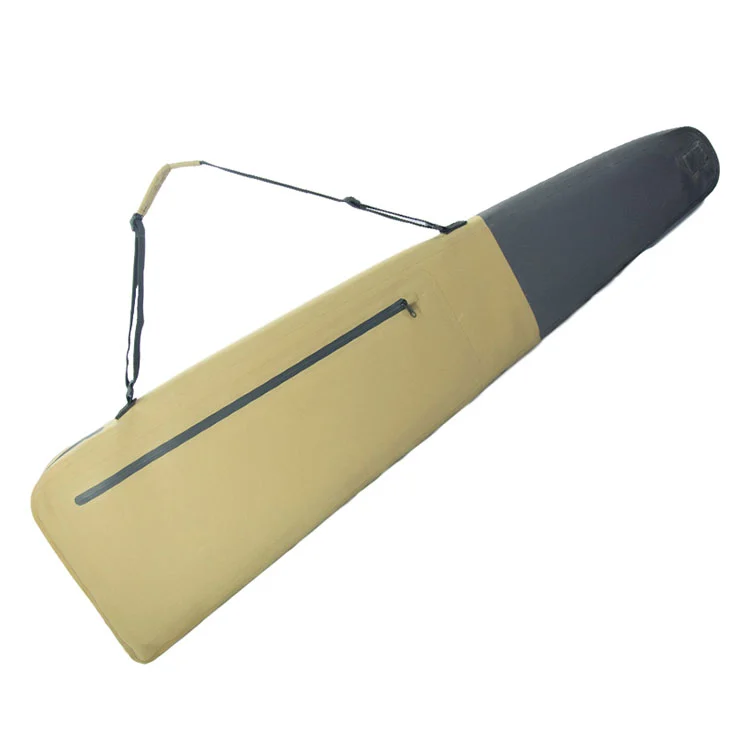
Retail appearance Utilitarian tube Gun-shaped silhouette

A contoured case reads as more tailored on a shelf. A tube performs better once it is loaded, stacked, and lashed. Buyers generally choose based on whether their market prioritises shelf appeal or field durability.

Packing and Terms

Item Specification
Individual packing PE protective bag
Carton 132 × 32 × 32 cm, 4 pcs, 5.4 kg net
Empty-state storage Rolls flat, no fixed volume retained
MOQ 300 pcs
Sample lead time 7–10 days
Production lead time 30–45 days
Trade terms EXW / FOB / CIF
Certifications ISO 9001, BSCI, SMETA, GRS (material dependent)

In the Box

Included Item Quantity
Tubular Waterproof Gun Case (SL-E302) 1
Adjustable Removable Shoulder Strap 1
Backpack Straps 1 set
Sealing Instruction Card 1
PE Protective Bag 1

Service and Support

• 12-month warranty against manufacturing defects, including welded seams and base

• Replacement POM buckles supplied for dealer service programmes

• Diameter and length consultation for specific firearm ranges

• Welding parameter records retained per project for OEM quality files

• Electrode tooling development for custom diameters

Project Notes

Project:

Diameter Specification for a Mixed Rental Fleet

A rental operation running scoped bolt-action rifles alongside shotguns with extended magazine tubes had been stocking two contoured case models, because neither profile fitted the other firearm type. Staff were matching cases to guns at issue and re-matching them at return.

A single tube with a uniform 25 cm internal section accepted both. The order specified numbered identification patches so cases stayed with their assigned firearm, and the operation retired the second case model.

  • Initial order: 500 pcs

• Customized features: 25 cm uniform diameter, numbered welded ID patches, lashing point configuration for boat racks

  • Sample lead time: 8 days
  • Production lead time: 40 days

• Outcome: Two case models consolidated to one; issue and return handling time reduced across the fleet

What Buyers Told Us

“One internal profile for the whole fleet ended the sorting problem. Any case takes any gun.”

— Fleet Manager, Rental Operation

“Our shotguns with extended tubes never fitted a contoured case properly. There is no taper on this one, so the magazine has room.”

— Head Guide, Waterfowl Outfitter

“They get stacked under decoys and gear on the deck all season. A flat case would have creased along the same edge by now.”

— Charter Operator, Boat Hunting

Buyer Questions

Why a tube rather than a gun-shaped case?

A circle encloses more area per unit of perimeter than any other shape. The 25 cm section encloses 491 cm² against roughly 226 cm² for a typical flat case, which over a 130 cm length is 63.8 L against 29.4 L — 2.17 times the volume for 14% more fabric across the perimeter.

Does the tube take more space than a contoured case?

Loaded, it is bulkier in profile. Empty, it rolls flat and retains no fixed volume, while a contoured case keeps its shape. For storage and transport the tube is the more compact of the two.

How does a tube handle being stacked under gear?

A circular section distributes pressure as tension around its full circumference rather than as bending concentrated at a panel centre and folded edges. In compression testing the shape recovered with no permanent deformation.

What is torsional stiffness and why does it matter?

It is resistance to twisting along the length. A closed circular section resists wringing far better than a flat one, which keeps a 130 cm case from twisting around the firearm when it is lashed to a moving vehicle or boat.

Will a scoped rifle fit?

The 25 cm internal diameter is uniform along the full length, so clearance at the receiver equals clearance at the muzzle and an optic clears without a dedicated recess. Diameter is customizable for larger optic and mount combinations.

Does it suit a shotgun with an extended magazine tube?

Yes. A contoured case narrows toward the muzzle, which is where extended magazine tubes run out of room. The tube does not taper, so the magazine has the same clearance as the receiver.

Is loading really faster?

There is no rotational alignment to get right — the cross-section is identical at every angle around the axis, and the mouth opens to a full 39 cm flattened width. That matters most in the dark, with cold hands, or when casing a fleet of different firearms.

Does the tube crease where a flat case would?

No fixed fold line exists, so the contact point rotates with handling rather than fatiguing the same edge. Repeated roll-flat cycling in testing produced no cracking or delamination of the tube wall.

How many seams does it have?

A tubular layout uses a minimal seam count compared with the multiple shaped panels of a contoured case. Fewer seams means fewer potential failure points and a smooth interior with no ridges against the firearm.

Can the diameter be changed for our market?

Yes. Both diameter and length are customizable, and electrode tooling is developed in-house for custom sections. Buyers commonly run two or three diameters to cover different firearm categories.

What holds it in place on a boat or vehicle?

Welded lashing patches take a strap or line, and the lashing point configuration is customizable. The circular body settles under its own contents rather than sitting proud on a curved deck.

What are the commercial terms?

MOQ 300 pcs, samples in 7–10 days, production in 30–45 days, quoted EXW, FOB, or CIF. Full OEM and ODM development is supported including diameter, length, material, branding, and packaging.

Send Inquiry
Contact Info
Send your inquiry to Sealock, submit your requirements here. We provide prompt response support services for hunting equipment brands worldwide.
X
We use cookies to offer you a better browsing experience, analyze site traffic and personalize content. By using this site, you agree to our use of cookies. Privacy Policy
RejectAccept