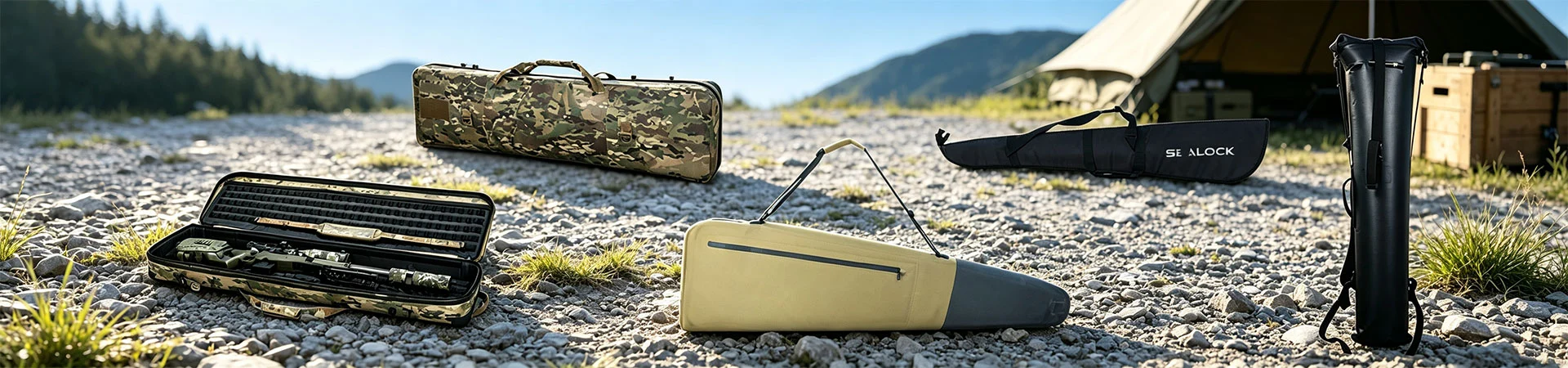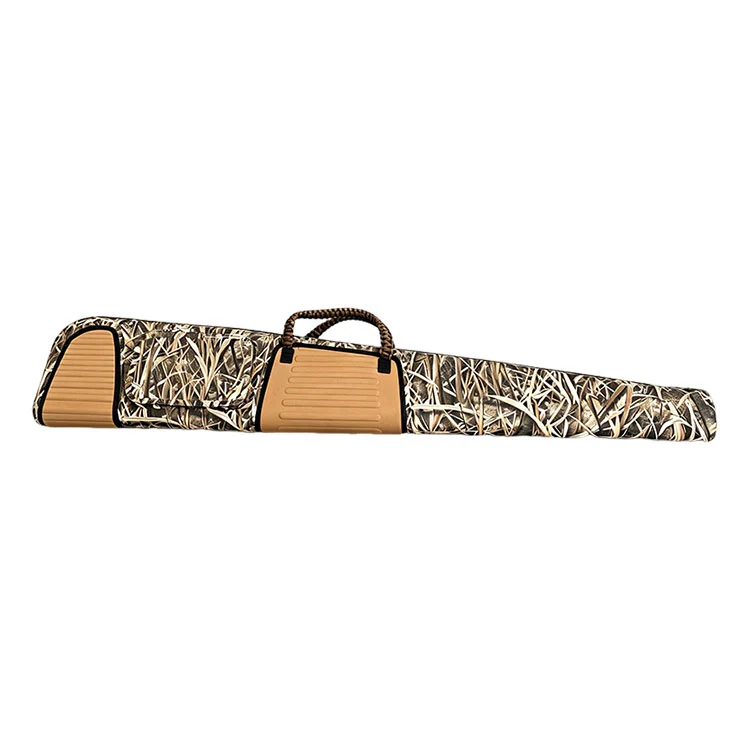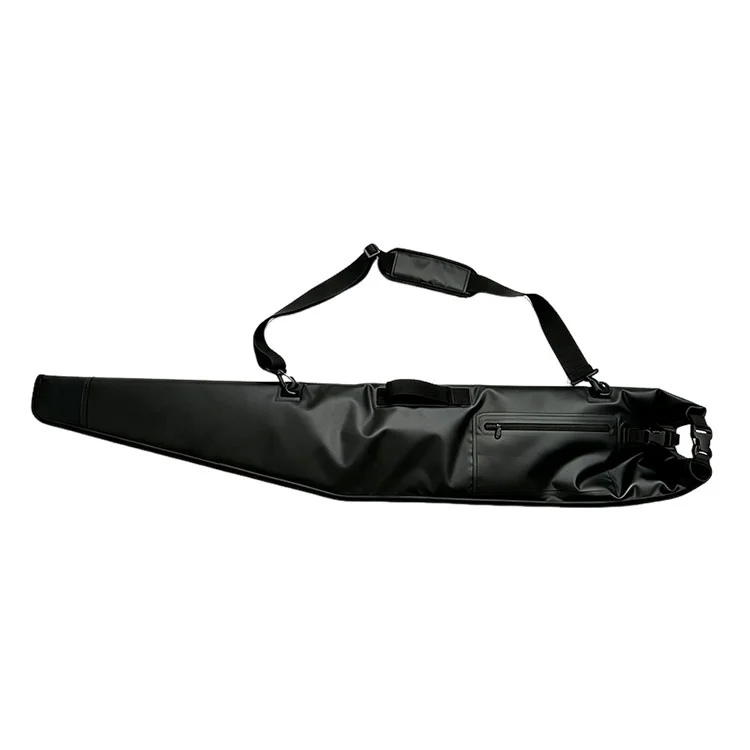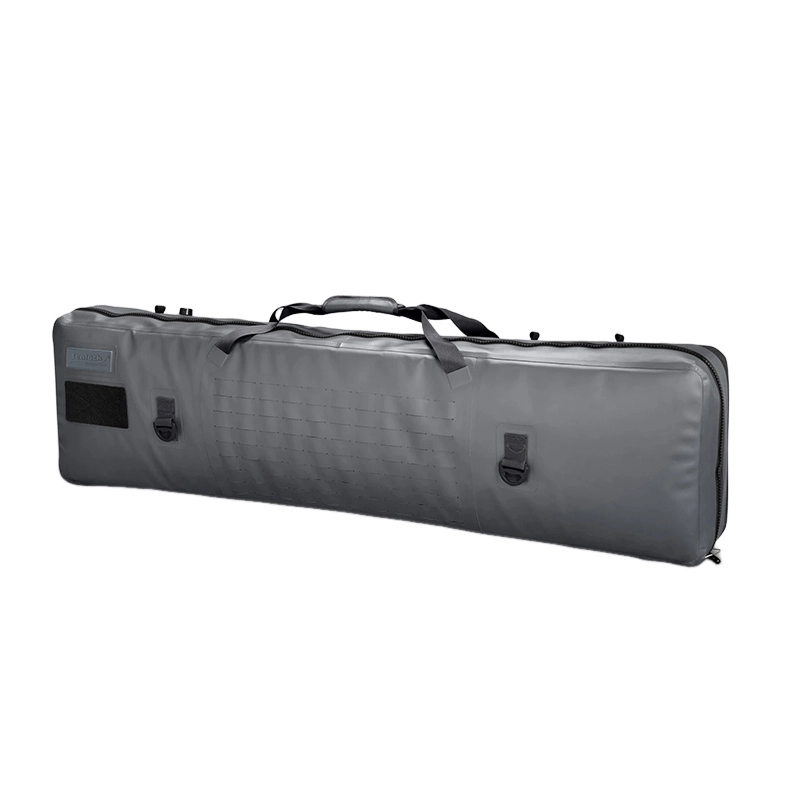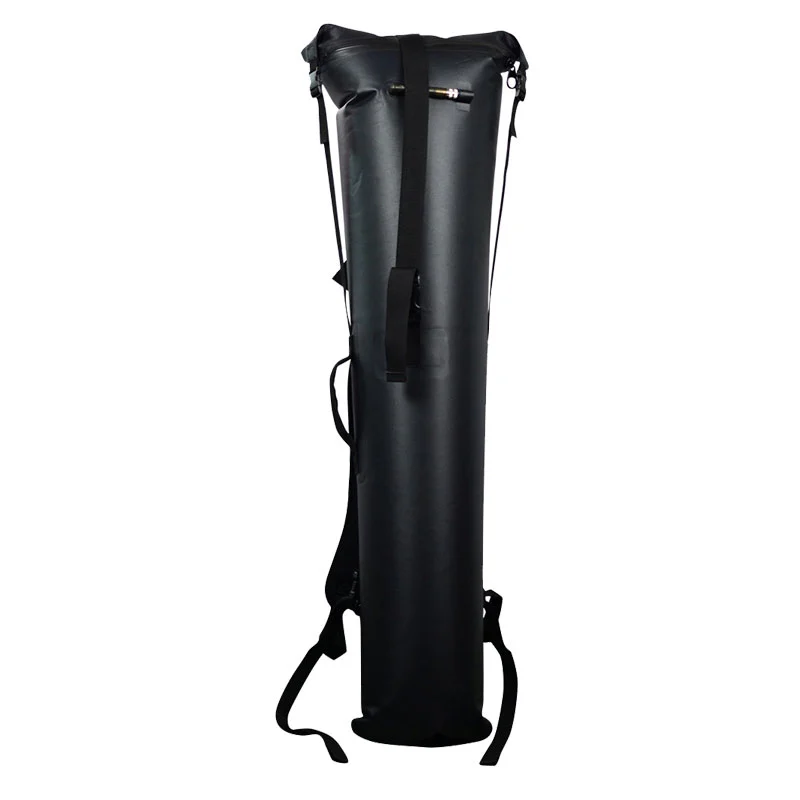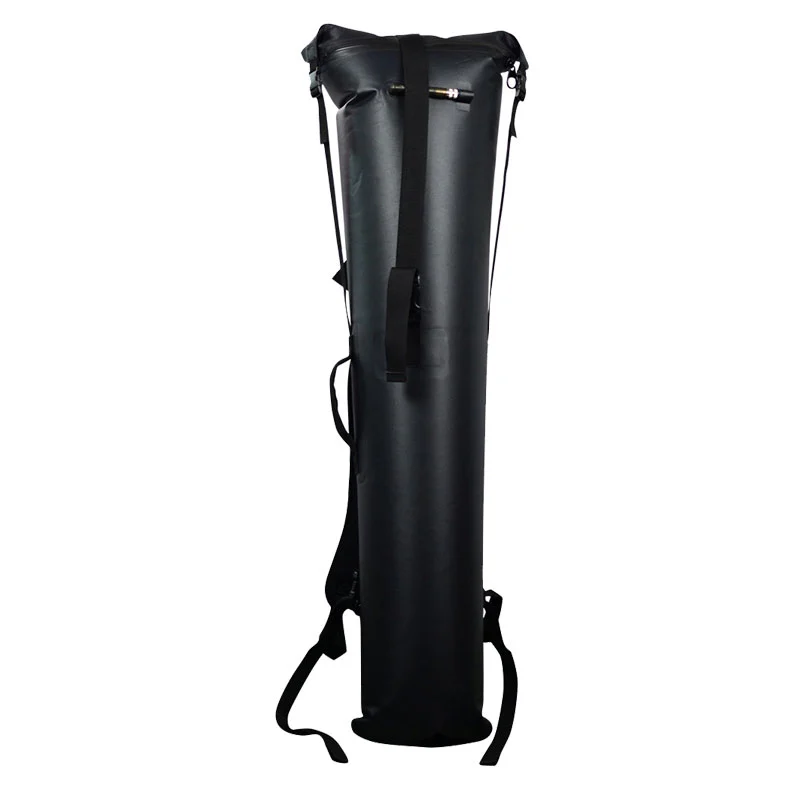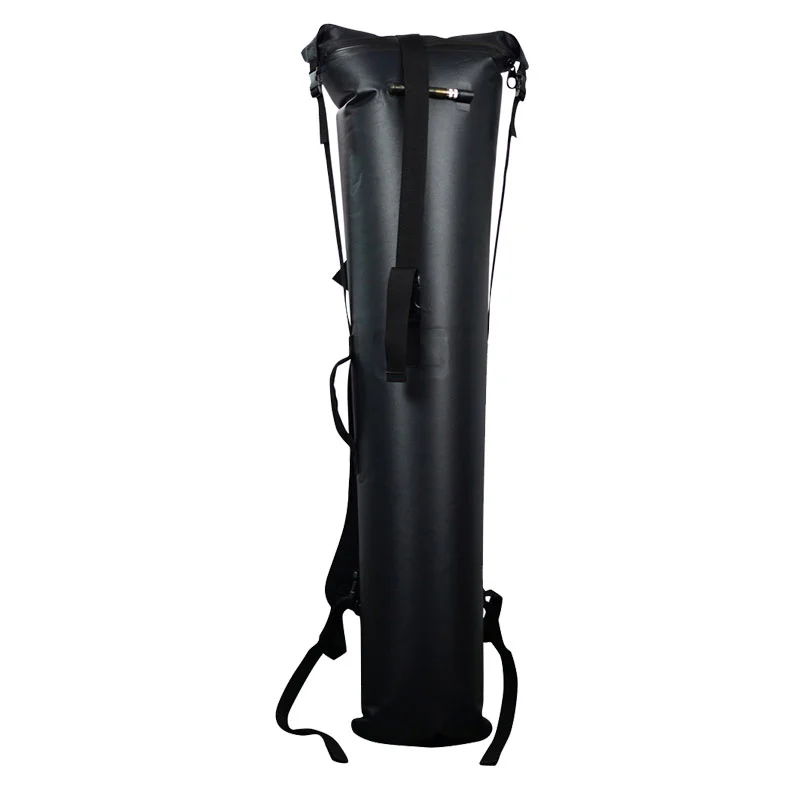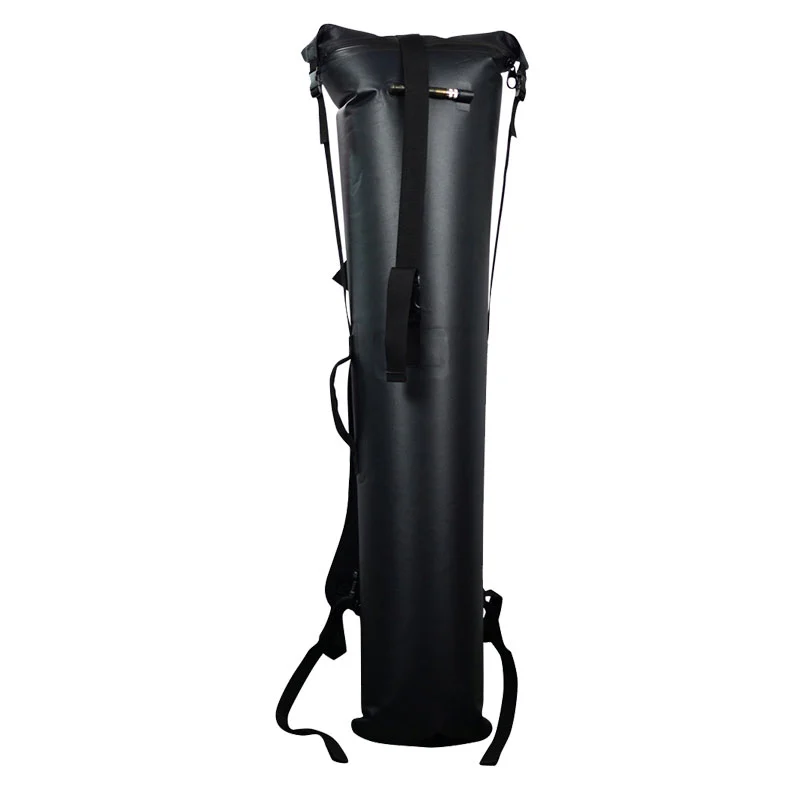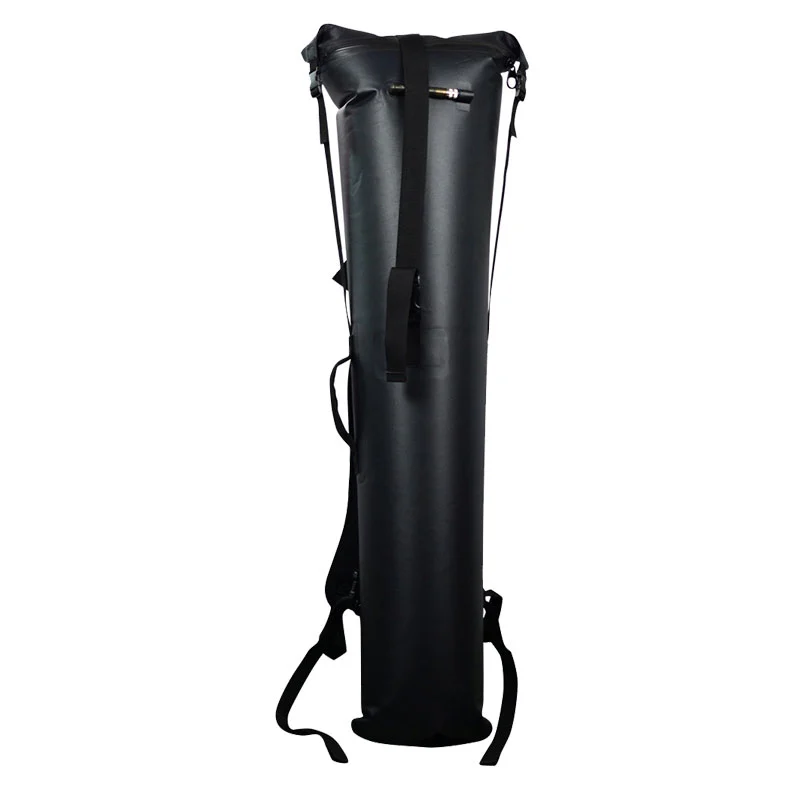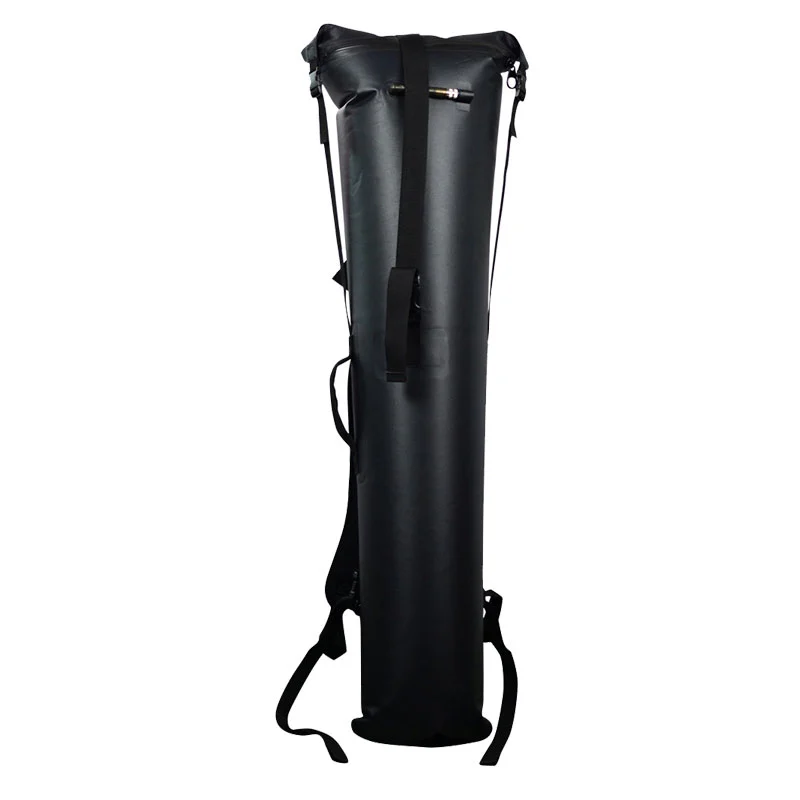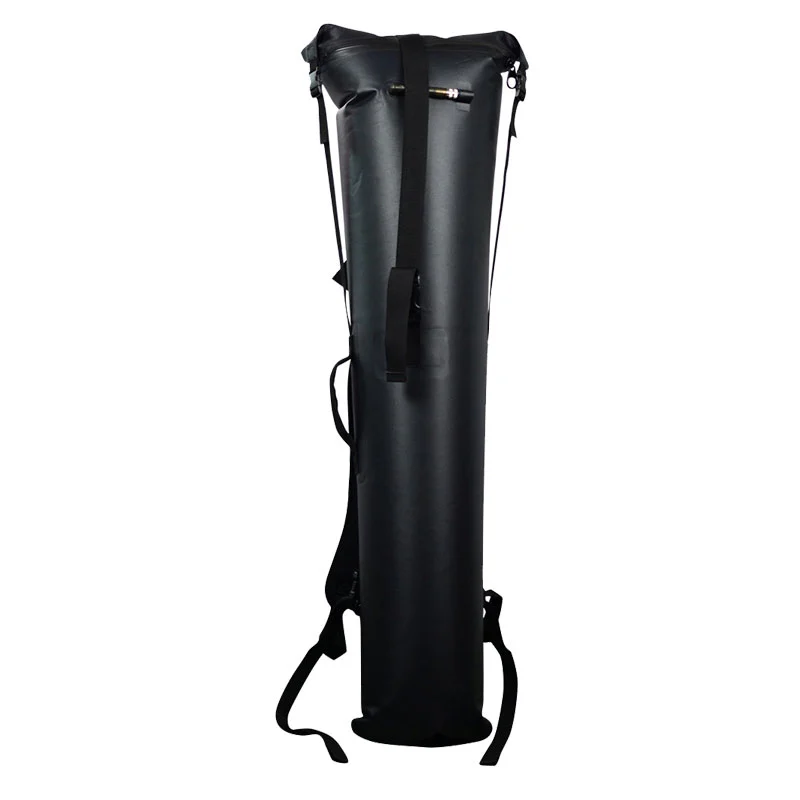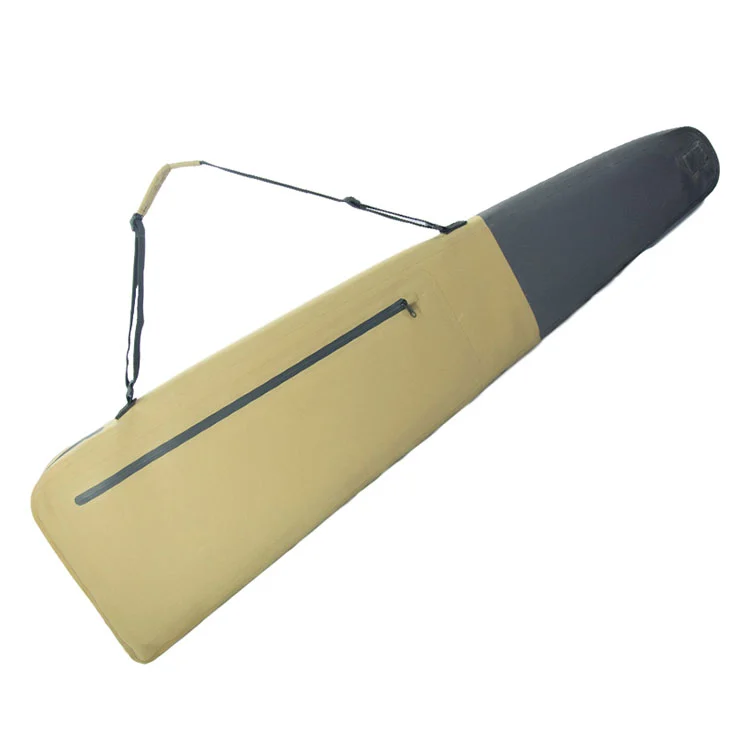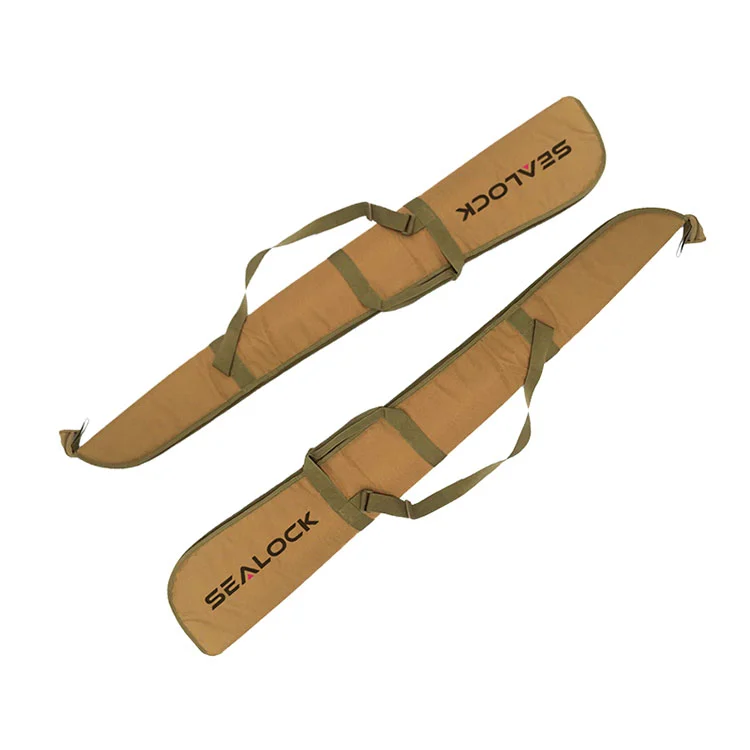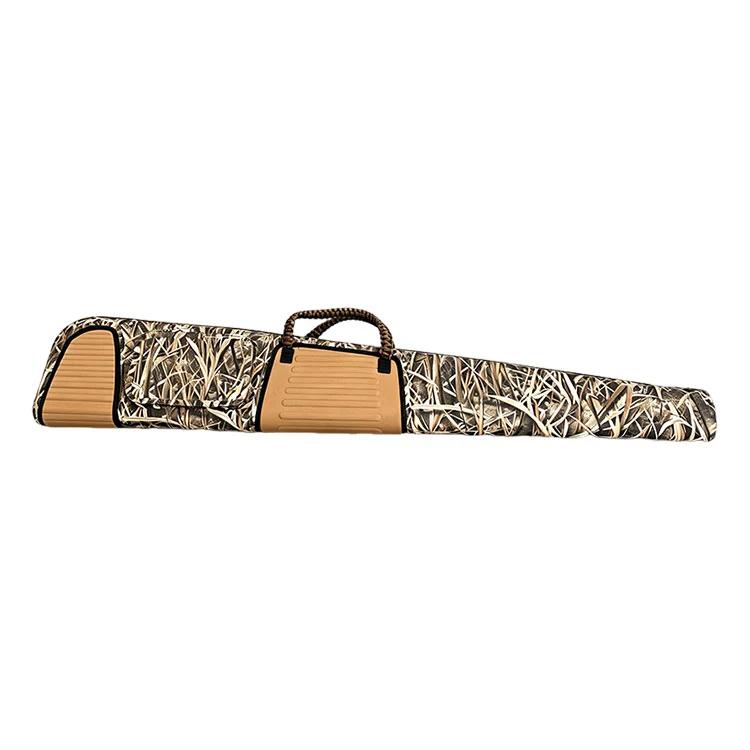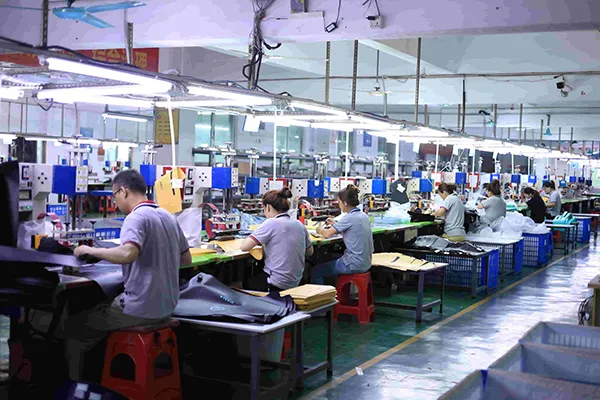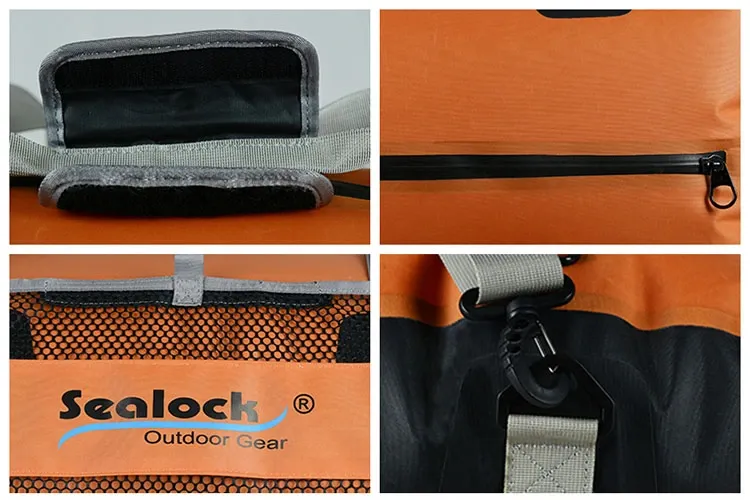
A gun case is designed to keep rain off a firearm. A dry bag is designed for the moment the firearm goes into the water — a slip on a bank, a swamped canoe, a bag knocked off a boat deck. The SL-E302 is built to the second standard: an RF welded 840D TPU tube, sealed by a three-fold roll-top, rated IPX7 for immersion in one metre of water for thirty minutes.
A dropped bag is normally recovered within a minute or two. The seal is verified to hold for thirty.
SL-E302 in backpack carry configuration
| Specification | Value |
| Model | SL-E302 |
| Waterproof Rating | IPX7 — immersion to 1 m for 30 minutes |
| Dimensions | 130 × 25 cm (51.2 × 9.8 in) |
| Usable Capacity | 60 L |
| Net Weight | 1.35 kg ± 0.15 kg |
| Shell Fabric | 840D TPU laminated (500D PVC / 420D TPU optional) |
| Seams | RF welded — no stitch perforations |
| Closure | Roll-top, three folds, POM side-release buckles |
| Max Firearm Length | 50 in (127 cm) overall |
| MOQ / Sampling / Production | 300 pcs / 7–10 days / 30–45 days |
| Stage | Duration | What the SL-E302 Does |
| Entry | 0–2 seconds | Sealed tube displaces water; trapped air keeps the bag at the surface |
| Floating | 2 seconds onward | 60 L sealed volume provides positive buoyancy with a rifle inside |
| Recovery window | Typically under 2 minutes | IPX7 verifies the seal to 30 minutes — a margin of roughly 15× |
| Retrieval | — | Roll-top released; interior dry; firearm serviceable |
| Drying | 10–20 minutes | TPU surface wipes down; interior aired open, no absorbed water |
The buoyancy figure follows from the geometry. A sealed 60 L cylinder displaces up to 60 kg of water; a typical hunting rifle at 3.5–4.5 kg plus the 1.35 kg bag leaves a large volume of trapped air and a substantial positive margin. Rolling the closure with a deliberate air pocket rather than pressing the air out is what preserves it.
Denier is a measure of yarn mass — grams per 9,000 metres of fibre. At 840D the base fabric uses a heavier yarn than the 420D and 500D constructions common in general-purpose dry bags, which is what carries the abrasion resistance needed when a bag is dragged across gravel bars, boat decks, and truck beds.
The TPU lamination is the waterproof layer, and it is also what makes the fabric weldable. Three shell options are available, and they behave measurably differently:
| Property | 840D TPU (standard) | 500D PVC | 420D TPU |
| Net weight (130 cm bag) | 1.35 kg | approx. 1.6 kg | approx. 1.15 kg |
| Abrasion resistance | Highest | High | Moderate |
| Low-temperature flexibility | Remains pliable at -20°C | Stiffens noticeably | Remains pliable |
| Hydrolysis resistance | High | Moderate | High |
| RF weldability | Excellent | Excellent | Excellent |
| Relative cost | Highest | Lowest | Middle |
| Typical positioning | Premium and professional | Volume retail | Lightweight and backcountry |
Buyers running two price tiers commonly sample 840D TPU and 500D PVC against the same pattern and split their order between them, since the tooling and pattern set is shared.
Rain runs off a surface and applies almost no pressure to a seam. Water at one metre applies roughly 0.1 bar of steady pressure against every seam and closure simultaneously.
A stitched bag has thousands of needle perforations along each seam, covered by tape bonded with adhesive. Under immersion pressure the tape is the only barrier, and adhesive degrades with heat cycling, UV exposure, flexing, and washing. The SL-E302 shell is joined by radio-frequency welding, which fuses the TPU layers of two panels into one continuous section of material — there are no perforations to cover and no secondary layer to fail.
- RF welded seams throughout the cylindrical body — zero stitch perforations in the waterproof shell
- Carry points attached to welded reinforcement patches rather than sewn through the shell
- Reinforced circular base takes ground and deck abrasion without breaching the barrier
- Weld integrity verified by destructive peel test at the start of every production run
On a correctly welded sample the parent fabric tears before the seam separates. A seam that opens cleanly indicates under-welding and triggers a parameter review before production continues.
The roll-top seals by compression. Comparison testing at two, three, and four folds established the working figure:
| Roll Folds | Seal Performance | Notes |
| 2 folds | Not reliable under immersion | Insufficient compression across the opening |
| 3 folds | Reliable — the specified minimum | The basis of the IPX7 rating and the 60 L capacity figure |
| 4+ folds | Higher sealing pressure | Reduces internal length; used for shorter firearms |
- Sealing pressure increases with each fold rather than relying on a single seal line
- Internal length adjusts by fold count, so one 130 cm body fits firearms from short air rifles to 50 in shotguns
- POM side-release buckles hold roll tension; corrosion-free in salt water and operable with gloves
- No zipper anywhere on the product — nothing to clog with grit, corrode, or freeze shut
| Factor | SL-E302 Dry Bag | Zippered Gun Case |
| Design condition | Water contact as normal use | Rain resistance only |
| Immersion rating | IPX7 (1 m / 30 min) | Not rated |
| Seam construction | RF welded, no perforations | Stitched, tape dependent |
| Closure | Three-fold roll-top | Zipper track |
| Behaviour if dropped in water | Floats; interior stays dry | Water tracks along the zipper |
| Grit and salt | No mechanism to clog or corrode | Zipper binds and corrodes |
| Cold weather | Closure operable with gloves | Zipper can stiffen or freeze |
| Empty storage | Rolls flat | Retains shape |
| Item | Specification |
| Model Number | SL-E302 |
| Product Name | Waterproof Rifle Dry Bag |
| Product Type | Roll-Top Submersible Firearm Dry Bag |
| Structure | Welded Cylindrical Tube, Reinforced Base |
| Dimensions | 130 × 25 cm |
| Usable Capacity | 60 L |
| Net Weight | 1.35 kg ± 0.15 kg |
| Waterproof Rating | IPX7 — immersion to 1 m for 30 minutes |
| Closure | Roll-Top, three folds, POM side-release buckles |
| Carrying Style | Hand / Shoulder / Backpack |
| Firearm Compatibility | Bolt-Action, Hunting, Tactical, Air Rifles; Shotguns |
| Max Firearm Length | 50 in (127 cm) overall |
| Colour | Black / Pantone matched |
| OEM / ODM | Supported |
| Component | Material | Function |
| Shell | 840D TPU Laminated | Waterproof barrier; abrasion and hydrolysis resistant |
| Shell Options | 500D PVC / 420D TPU | Cost-optimised or lightweight alternatives |
| Seams | RF Welded | Continuous shell, no stitch perforations |
| Base | Reinforced Circular Base | Ground and deck abrasion resistance |
| Buckles | POM Side-Release | Corrosion-free; glove-operable |
| Webbing | Heavy-Duty Nylon | Load-bearing carry and compression points |
| Strap | Adjustable Removable Nylon | Shoulder and backpack carry |
| Option | Available | Notes |
| Shell Material | ✔ | 840D TPU / 500D PVC / 420D TPU |
| Custom Size | ✔ | Length and diameter both adjustable |
| Logo Printing / Reflective Logo | ✔ | Screen print, heat transfer, reflective |
| Pantone Colour Matching | ✔ | Confirmed at sampling |
| Camouflage Pattern | ✔ | Marsh, timber, or customer pattern |
| Accessory Pocket | ✔ | Internal or external |
| Drain Valve | ✔ | For programmes requiring water release |
| Name Card Window | ✔ | Fleet and rental identification |
| Packaging / Private Label | ✔ | Colour box, printed carton, hang tag |
A waterproof rifle dry bag of this rating suits any use where the firearm may enter the water rather than merely get rained on:
Kayak, canoe, and packraft transport, river crossings and deep wading, boat hunting and open-deck stowage, duck and waterfowl hunting in flooded terrain, coastal and estuary access, rafting and expedition water routes, ATV and snowmobile transport, and damp-environment and off-season storage.
1. 840D TPU fabric inspection and weldability confirmation
2. RF welding parameter setup for the fabric batch
3. First-article weld sample and destructive peel test
4. Precision cutting of cylindrical body panels
5. RF welding of shell seams
6. Reinforced base welding and patch application
7. Webbing, buckle, and compression strap installation
8. Shoulder and backpack strap assembly
9. Immersion and closure function inspection
10. Final quality inspection and export packing
| Inspection Item | Standard |
| Incoming Material Inspection (IQC) | Every batch |
| First-Article Weld Peel Test | Start of every run |
| Welded Seam Integrity | 100% |
| Roll-Top Closure Function | 100% |
| Immersion Verification | Per approved sampling plan |
| Dimensional Verification | Sampling |
| Appearance and Colour | 100% |
| Packaging Inspection (OQC) | 100% |
Third-party inspection by SGS or QIMA can be arranged on request and is commonly specified by importers building a compliance file.
| Test Item | Method | Result |
| IPX7 Immersion | Sealed bag immersed to 1 m for 30 minutes | No ingress at seams or closure |
| Flotation with Load | Sealed with retained air, rifle-weight load | Floated with contents above the surface |
| Weld Seam Peel | Destructive peel on welded sample | Parent fabric tore before seam separation |
| Roll-Fold Comparison | Sealed at 2, 3, and 4 folds, then immersed | Reliable sealing from three folds |
| Salt-Water Exposure | Immersion in salt water, rinsed and dried | No hardware corrosion; seams unaffected |
| Buckle Cycle | 3,000 clip and release cycles under load | Retained holding force, no cracking |
| Low-Temperature Flexibility | 12 hours at -20°C, then rolled and clipped | Fabric and closure remained pliable |
| Abrasion | Contact with gravel, rock, and boat decks | Cosmetic wear only, no structural damage |
Welded TPU tolerates rinsing and scrubbing that would lift the seam tape on a stitched bag.
1. Empty the bag completely, including any water that entered while it was open
2. Rinse the exterior and interior with fresh water — scrubbing is permitted, as there is no seam tape to lift
3. After salt-water exposure, rinse the buckles and webbing thoroughly
4. Dry with the bag open and unrolled rather than sealed
5. Store unrolled or loosely rolled, out of direct sunlight, to avoid setting a permanent crease at one fold line
| Item | Specification |
| Individual packing | PE protective bag |
| Carton | 132 × 32 × 32 cm, 4 pcs, 5.4 kg net |
| Volume per unit | 0.0338 m³ |
| MOQ | 300 pcs |
| Sample lead time | 7–10 days |
| Production lead time | 30–45 days |
| Trade terms | EXW / FOB / CIF |
| Third-party inspection | SGS / QIMA on request |
Shipping options include ocean freight (FCL / LCL), air freight, railway transportation, and international express.
| Included Item | Quantity |
| Waterproof Rifle Dry Bag (SL-E302) | 1 |
| Adjustable Removable Shoulder Strap | 1 |
| Backpack Straps | 1 set |
| Sealing Instruction Card | 1 |
| PE Protective Bag | 1 |
- 12-month warranty against manufacturing defects, including welded seams and closure
- Replacement POM buckles available for dealer service programmes
- Welding parameter records retained per project for OEM quality files
- Shell material consultation against target price point and climate
- Multilingual sealing instruction cards available
Project: Buoyancy Verification for a Whitewater Access Programme
A rafting-access hunting operation had lost two rifles in separate capsizes and needed to confirm, before committing to an order, that a sealed bag would actually float with a loaded rifle rather than sink slowly.
We supplied three samples in 840D TPU and the operator ran their own test, deliberately rolling a loaded raft. Both the sealing procedure and the retained air pocket proved decisive — bags rolled tight with the air pressed out floated low, while bags rolled with a deliberate air pocket rode high enough to spot in moving water. The operator standardised on the air-pocket procedure and ordered in a high-visibility colourway.
- Initial order: 250 pcs
- Customized features: High-visibility Pantone colourway, 840D TPU shell, tether anchor point, multilingual sealing card
- Sample lead time: 8 days
- Production lead time: 40 days
- Outcome: Two subsequent capsizes; both bags floated and were recovered with firearms dry
"We rolled a loaded raft on purpose to test it. The bag came up and stayed up — that decided the order."
— Programme Director, Whitewater Access Hunting
"The difference between rolling it tight and leaving an air pocket was obvious once we tested both. Your sealing card explains it; ours did not."
— Safety Officer, Guiding Operation
"840D against 500D PVC was a 250 gram difference and a real cost difference. Sampling both let us split the order sensibly."
— Purchasing Manager, Outdoor Distributor
IPX7 under IEC 60529 is protection against immersion in one metre of water for thirty minutes. In field terms that covers a bag dropped off a boat, a swamped canoe, or a slip during a river crossing — situations where recovery normally takes a minute or two against a seal verified to thirty.
A sealed 60 L cylinder displaces up to 60 kg of water. With a typical 3.5–4.5 kg rifle and the 1.35 kg bag, a large volume of trapped air remains and the bag carries substantial positive buoyancy. Roll the closure with a deliberate air pocket rather than pressing the air out — that is what preserves it.
Comparison testing at two, three, and four folds established three as the reliable minimum. Two folds do not generate sufficient compression across the opening. Three folds is also the basis of both the IPX7 rating and the 60 L usable capacity figure.
Denier measures yarn mass — grams per 9,000 metres of fibre. At 840D the base fabric uses a heavier yarn than the 420D and 500D constructions common in general-purpose dry bags, which is what carries the abrasion resistance needed on gravel bars, boat decks, and truck beds.
840D TPU for premium and professional positioning, 500D PVC for volume retail at roughly 250 g heavier and lower cost, and 420D TPU where light weight matters most. All three weld equally well and share the same pattern, so buyers commonly sample all three and split an order between tiers.
Immersion applies steady pressure that rain never does. A stitched bag relies on tape over thousands of needle perforations, and tape adhesive degrades with heat cycling, UV, flexing, and washing. Welding fuses the material with no perforations, so there is no secondary layer to fail.
Yes. The TPU shell is unaffected by salt and the POM buckles do not corrode. Rinse the hardware and webbing with fresh water afterwards — the welded construction tolerates full rinsing, as there is no seam tape to lift.
Welding parameters are set per fabric batch and a first-article sample is destructively peel-tested at the start of every run. On a correct weld the parent fabric tears before the seam separates; a clean seam separation indicates under-welding and triggers a parameter review.
Up to 50 inches (127 cm) overall in the 130 cm body, leaving length for the three roll folds. Shorter firearms are accommodated by rolling further. Length and diameter are both customizable.
Rinse inside and out with fresh water, scrubbing if needed, then dry open and unrolled. Store unrolled or loosely rolled and out of direct sunlight, so a permanent crease does not set at one fold line.
Yes. Pantone colour matching is standard, and expedition and guiding customers commonly specify a high-visibility shell precisely so a bag lost in moving water can be spotted and recovered.
MOQ 300 pcs, samples in 7–10 days, production in 30–45 days, quoted EXW, FOB, or CIF. Full OEM and ODM development is supported including material, size, colour, branding, accessories, and packaging.
Address
No. 88, Fenggang Section of Dongshen Road, Fenggang Town, Dongguan City, Guangdong Province, China
Tel