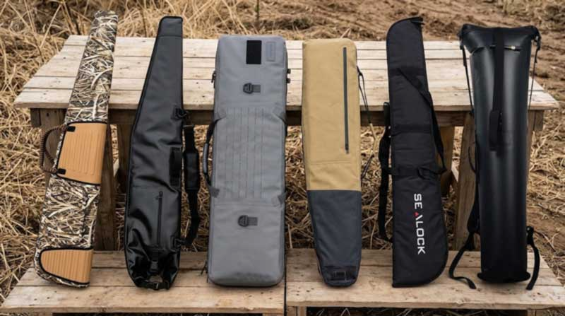
This guide covers what a soft rifle case can and cannot protect against, how to size one for length and for optic height, what padding and retention actually do, how weather rating changes the construction, and what a brand should specify when developing its own soft rifle case line.
A soft rifle case is built for the knocks of ordinary transport: the rifle sliding across a truck bed, a case dropped from tailgate height, a stock rubbing against a door frame, gravel and brush scraping along the fabric. Foam spreads the force of an impact over a wider area and lengthens the time it takes to arrive. The lining keeps the finish off the shell fabric, and a snug fit keeps the rifle from building up speed inside the case before it hits the wall.
It does not protect against crushing. A soft case under a load of gear, or under a cooler that slides in a sharp turn, passes that load straight to the scope. It is not approved for air travel either. US airlines require firearms to fly unloaded in a locked, hard-sided container, so a soft case goes inside the hard case and comes out at the other end. A stitched soft case is also water-resistant rather than waterproof, which is covered further down. Where a hard case is the better choice, and where it is not, is covered in Soft vs Hard Gun Cases: What Hunters Actually Give Up With Each.What the airline rule actually requires is set out in Flying With a Hunting Rifle. A stitched soft case is also water-resistant rather than waterproof, which is covered further down.
On the question every rifle hunter asks, whether a case can keep a scope's zero, the honest answer is that it helps, but it is not the main factor. When hunters compare notes on rifles carried in ATV racks, gun boots and soft cases, the pattern is consistent. Zero shifts trace back far more often to scope rings and base screws that have loosened, or to one hard knock, than to normal vibration in transport. A good case prevents the hard knock. A torque wrench on the mounts prevents the rest. Hunters who have had a scope move once tend to check both, and to confirm zero at camp before the first morning.
As with shotguns, rifles are sold by barrel length and cases by external length, and the two numbers do not translate directly.
A typical bolt-action hunting rifle adds around 20 inches to its barrel length. A Tikka T3x Hunter with a 22.4-inch barrel, for example, measures 42.8 inches overall. A rifle with a 24-inch barrel lands at roughly 44 to 45 inches, and a 26-inch magnum barrel at about 46 to 47. Three things then add length that the specification sheet leaves out.
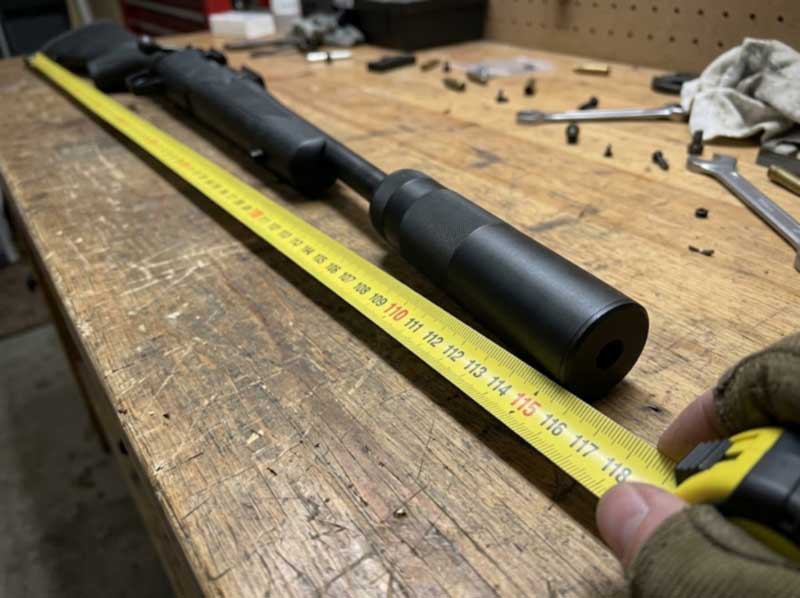
Suppressors. A hunting suppressor commonly adds six to nine inches. Many hunters want to case the rifle with the suppressor fitted, because taking it off and putting it back on can shift the point of impact. A 42.8-inch rifle with a suppressor becomes a 50-inch package.
Muzzle brakes. These add one to three inches, and their sharp ports wear through lining and fabric at the muzzle end faster than a plain crown.
Bipods. A bipod folded under the fore-end adds depth more than length, but a swivel-mounted bipod can extend past the fore-end tip.
Measure the rifle exactly as it will be carried, from the back of the recoil pad to the end of the muzzle device. Then compare that with the case's internal length, which is typically one to two inches less than the external length, because padding and end forming take up the difference. Common soft rifle case lengths fall into a few bands.
| Rifle as carried (overall) | Typical case length (external) | Examples |
|---|---|---|
| Up to about 38 in | 40–42 in | Short carbines, compact bolt-actions with 16–18 in barrels |
| About 40–44 in | 44–46 in | Standard bolt-actions with 20–22 in barrels |
| About 44–46 in | 48 in | 24 in barrels; 22 in barrels with a brake |
| About 46–51 in | 52–54 in | 26 in magnum barrels; suppressed rifles with 20–22 in barrels |
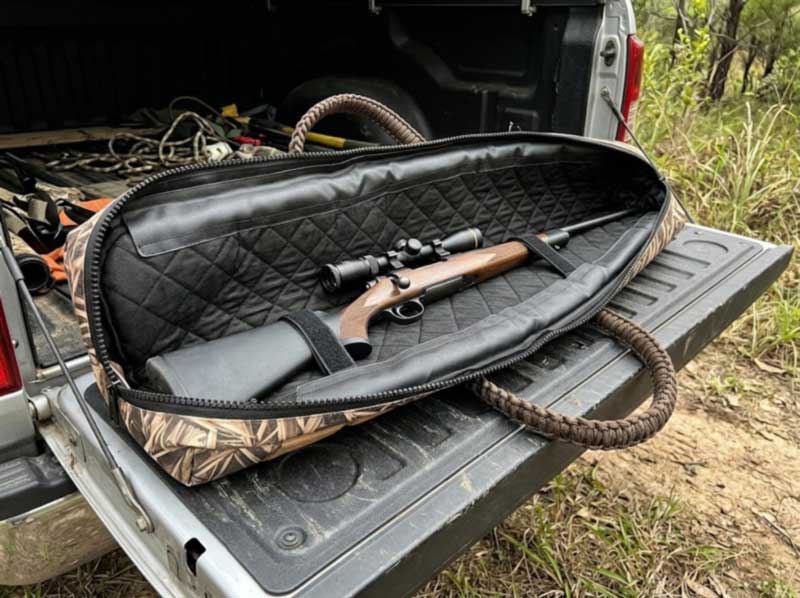
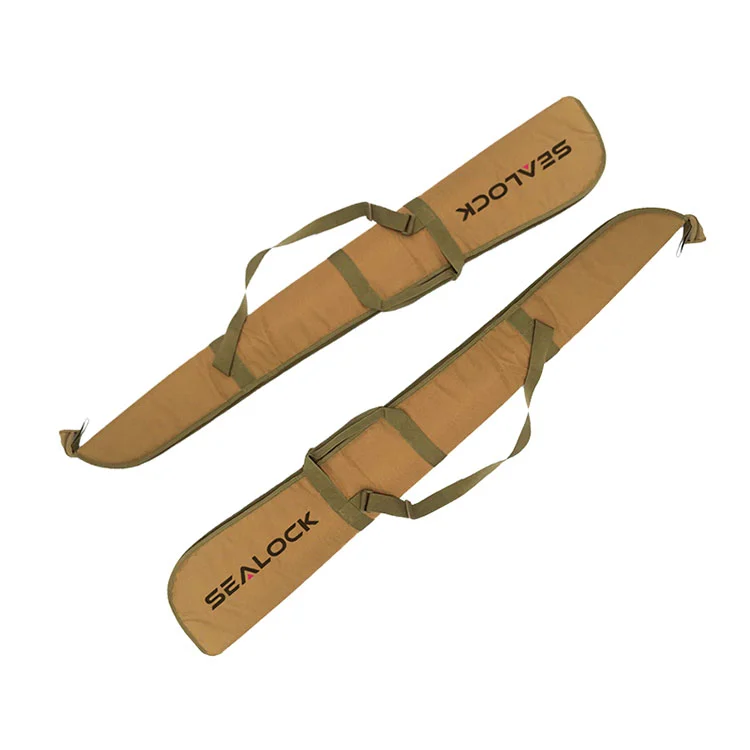
Sealock's SL-P1076 padded rifle case sits at the long end of this table. It is 134 cm (52.8 inches) external, with an estimated internal length of 128–130 cm, for rifles up to roughly 127–130 cm (50–51 inches) overall. It takes most standard and magnum-length bolt-actions, and many suppressed rifles, without removing the suppressor.
Length decides whether the rifle goes in. Height decides whether the scope survives. Three dimensions set the case height at the action.
The objective bell on a scope with a 50 mm or 56 mm objective sits well above the barrel line, and it is the first part to hit when a case is dropped muzzle-first. The turrets stick out to the side and top, and exposed target turrets on long-range scopes are both the tallest and the most vulnerable part of the rifle. The bolt handle sticks out sideways and pushes into the lining on one side.
A case that is cut in a straight line, or with a gentle taper and a full-height section at the action, leaves room for all three. A sharply tapered shotgun-style case squeezes the turrets and the objective into the padding. Over months, that squeeze turns a turret or bends a flip-up cover. Scope covers add height as well. Check the case with the covers on.
Optic clearance, scope heights and how to measure a scoped rifle for a case are covered in more detail in a separate guide on scoped rifle cases.
More foam is not always better in a rifle case. A thick, rigid foam protects well, but it makes a case that cannot be folded or rolled into a pack or a plane's cargo net, and it is heavy to carry all day. Some hunters who carry a case into camp and leave it there want a soft case that packs down. Others want maximum protection on long road trips and never fold the case at all.
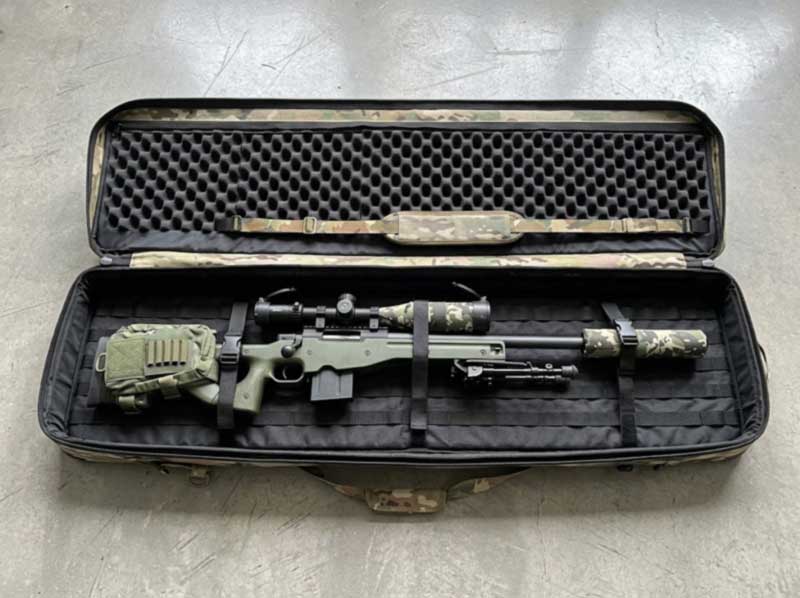
The practical range runs from about 10 mm of foam, for light cases carried on the walk in, through 15–25 mm, for general truck transport, to 40 mm, for maximum protection. The SL-P1076 uses a removable 40 mm multi-layer gun pad inside a quilted lining. The pad can be taken out to dry, or sold separately as a spare. The SL-C811 uses EVA foam at 20–25 mm in the lid, 15 mm in the base and 10 mm at the sides. That puts the thickest protection over the optic, where it is needed, and keeps the overall case thinner.
Foam type matters as much as thickness. Closed-cell foams such as EVA and PE do not soak up water and keep their shape. Open-cell foams are softer and cheaper, but they hold moisture against the rifle. That is one reason soft cases get blamed for rust that the gun brought in with it.
Padding protects a rifle that hits the case wall. Retention stops it hitting the wall in the first place. A rifle that can slide an inch inside its case gathers speed before it hits the foam, and that is when scopes move.
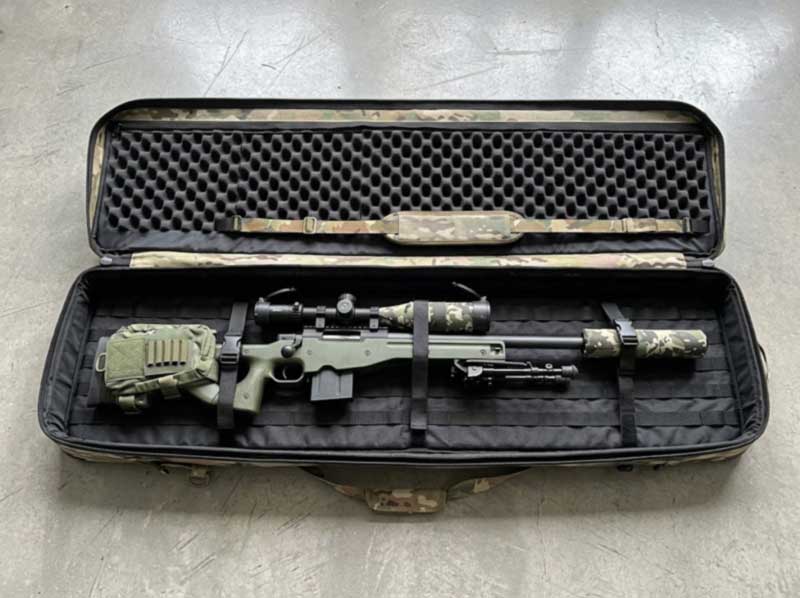
Retention comes from three things: a case cut close to the rifle's profile, straps at the stock and fore-end, and padding that grips rather than lets the rifle slide. The SL-C811 uses six to eight adjustable retention straps inside, so one case can be set up for different rifles. A tapered padded case with no straps relies on its fit, which works well for the rifle it was cut for and less well for anything shorter.
Ask any shop that handles returns where soft rifle cases fail, and the answer is usually the muzzle end of the zipper. When the zipper runs right to the end, the crown, brake or suppressor bears on the zipper chain every time the rifle goes in or out, and the teeth separate at that spot. Better cases stop the zipper short of the barrel tip and close the end with a reinforced cap, so the muzzle rests against fabric and foam instead of teeth. A two-way zipper lets the case be opened at the action without exposing the whole rifle. Lockable pulls, such as those on the SL-P1076, allow a small padlock or cable tie through both sliders. That is useful in storage and when the case travels inside a hard case or a vehicle.
How a case is carried matters more than buyers expect. A single handle at the centre is fine from truck to range bench. A shoulder strap is the minimum for anything further. For a walk-in to a stand or a hunt across rough ground, a backpack harness leaves both hands free and puts the weight on the hips and shoulders rather than one arm. Hunters who have carried a rifle case a mile by its handle tend to make this their first complaint. The SL-C811 carries backpack straps, a detachable shoulder strap and a reinforced handle, and the SL-P1076 uses twin braided rope handles and an adjustable, detachable strap.
Most soft rifle cases are stitched polyester Oxford with a water-resistant coating. They shed rain, snow and dew, and they will keep a rifle dry on the walk from the truck in a downpour. They will not keep water out if the case sits in water or rides in the bottom of a boat, because stitched seams let water through under pressure. The SL-P1076 is a good example of where the line falls. It has a heavy-duty waterproof zipper with lockable pulls, but its stitched 600D body makes the case water-resistant overall, and it carries no IPX rating.
When a rifle will be around open water, flooded ground or heavy, sustained rain, the case needs a welded shell. The SL-E603 waterproof rifle case is one-piece welded 840D TPU with a sealed zipper, a welded waterproof accessory pocket and a contoured rifle profile, rated IPX7. The SL-C811 combines a welded TPU shell rated IPX6 with full EVA padding and laser-cut MOLLE on a welded panel, so it stays waterproof in storms and spray while carrying the padding a scoped rifle needs. How water gets into a case, and what IPX6 and IPX7 mean in practice, is covered in Waterproof Gun Cases: What Actually Keeps Water Out.
| Use | What matters most | Build | Sealock model |
|---|---|---|---|
| Truck to stand, dry weather, valuable optic | Optic protection, length for suppressor | Stitched, 40 mm removable pad, lockable zipper | SL-P1076 |
| Long walk-in, foul weather, gear on the outside | Hands-free carry, retention, weather | Welded TPU, IPX6, EVA padding, backpack straps | SL-C811 |
| Boat, marsh, flooded ground | Immersion protection | One-piece welded TPU, IPX7 | SL-E603 |
| Range trips and short drives | Weight, quick access | Stitched, 10–15 mm foam | OEM build on request |
Soft double rifle cases carry two rifles side by side, separated by a padded divider. They suit range days and hunters who bring a backup rifle. The compromise is bulk and weight, and with two scoped rifles, the optics need to be offset so the turrets do not stack. Double and multi-rifle soft cases are built to order rather than kept as a standard model. They are a pattern and divider decision on top of the same materials and construction.
A soft rifle case specification starts with the reference rifles: overall length as carried, with any suppressor or brake fitted; height at the objective and the turrets; the side the bolt handle is on; and whether a bipod stays mounted. From there, choose the profile (straight or tapered), padding thickness and foam type, retention method, zipper layout, carry system, and weather rating.
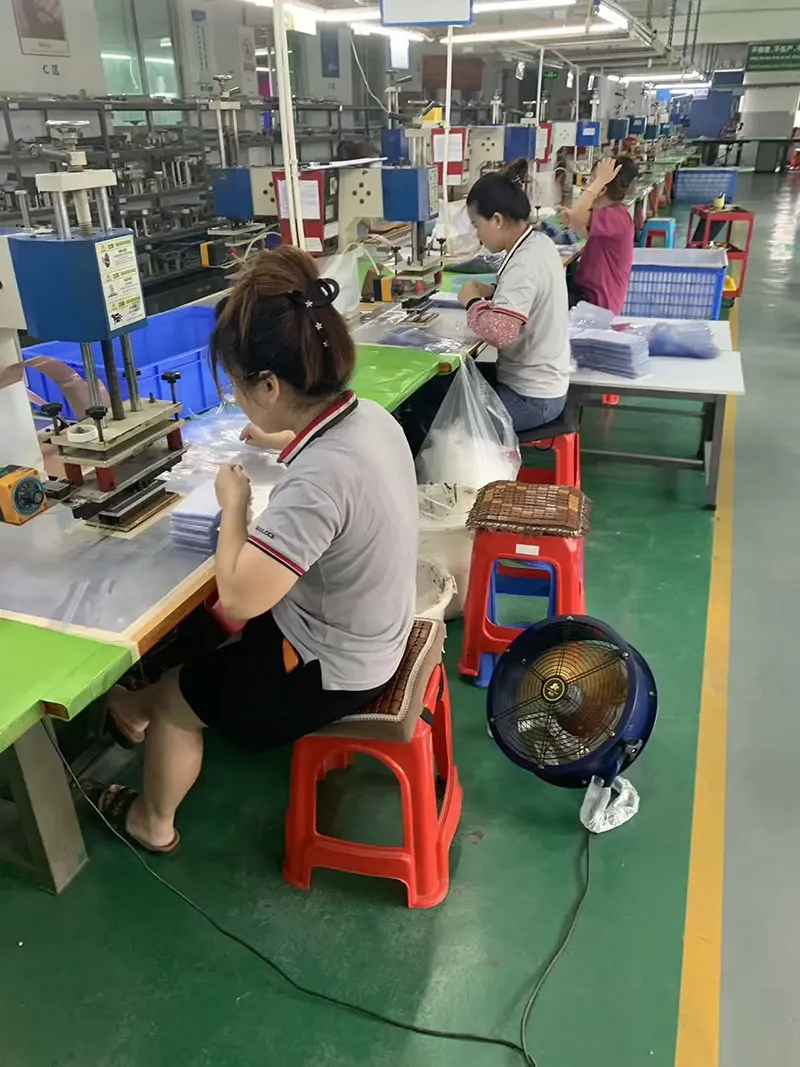
Sealock builds stitched and welded rifle cases in the same plants in Dongguan and Ho Chi Minh City, so a brand can run a padded water-resistant case and a welded waterproof case through one supplier and one quality team. Minimum orders are 300–500 pieces per model, depending on construction. Samples are usually ready in 7–15 days from a confirmed specification, and production takes 30–45 days. Fully new patterns or welding moulds take longer than changes to an existing model, and that time is planned in from the first quote. Case length, taper, pad thickness, camouflage or solid colours, handles and logos are all specifiable. Strap anchors and zippers are load-tested to more than 1,500 cycles and fatigue-tested to 3,000 cycles, and welded models go through immersion or water-jet testing to their rating, with SGS or QIMA inspection available.
For shotgun sizing, which follows different rules, see Soft Shotgun Cases: Length, Padding, Profile and the Gun Slip Question. For an overview of all hunting bag types, see Hunting Bags Explained. AR-15s, with adjustable stocks, optics and magazines, follow their own sizing rules, covered in AR-15 Cases: 36, 42 or Longer.
A bolt-action with a 24-inch barrel is usually about 44 to 45 inches overall, so a 48-inch case fits it with room for the padding. With a suppressor fitted, it moves into the 52- to 54-inch range. Measure from the recoil pad to the end of the muzzle device, and compare that with the case's internal length, not its external length.
It protects the scope from the knocks that move it, but loose rings and bases are the more common cause of zero shift. Torque the mounts to the manufacturer's specification, keep the rifle from sliding around inside the case, and confirm zero at camp after a long trip.
The muzzle, brake or suppressor rests on the zipper chain each time the rifle goes in or comes out. Choose a case whose zipper stops short of the barrel tip with a reinforced end cap, and make sure the case is long enough for the rifle as you carry it.
Only for short periods. A soft case holds any moisture the rifle brought in, and storing it in a warm room or a vehicle invites rust. Between seasons, store the rifle out of the case, or in a breathable silicone-treated gun sock, in a dry place.
A stitched one is water-resistant only, even if it has a waterproof zipper. For rifles carried around open water or in heavy, sustained rain, choose a welded TPU case with an IPX6 or IPX7 rating.
Minimum orders are 300–500 pieces per model, depending on construction, and colours and logos can vary within one order. Logos can be screen-printed, heat-transferred, embroidered or applied as a woven label. Pricing depends mainly on length, padding, construction and quantity, so send your reference rifles for an accurate quote.
Browse the soft gun cases and rifles and tactical gear ranges, or send your reference rifles, target market and weather requirement to info@sealock.com.hk or through the contact page. We will come back with a profile and padding recommendation, construction options and a sample plan.
-