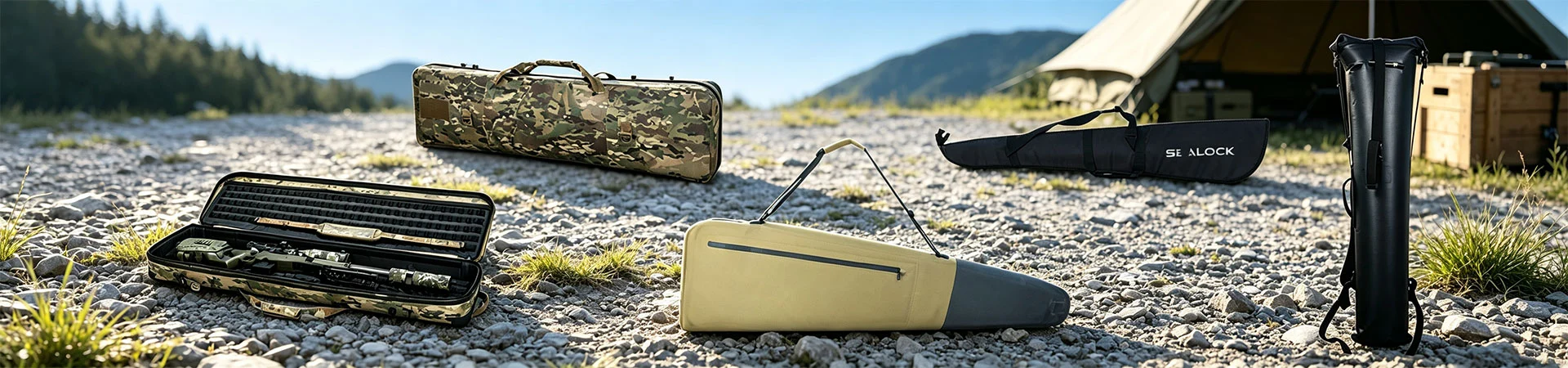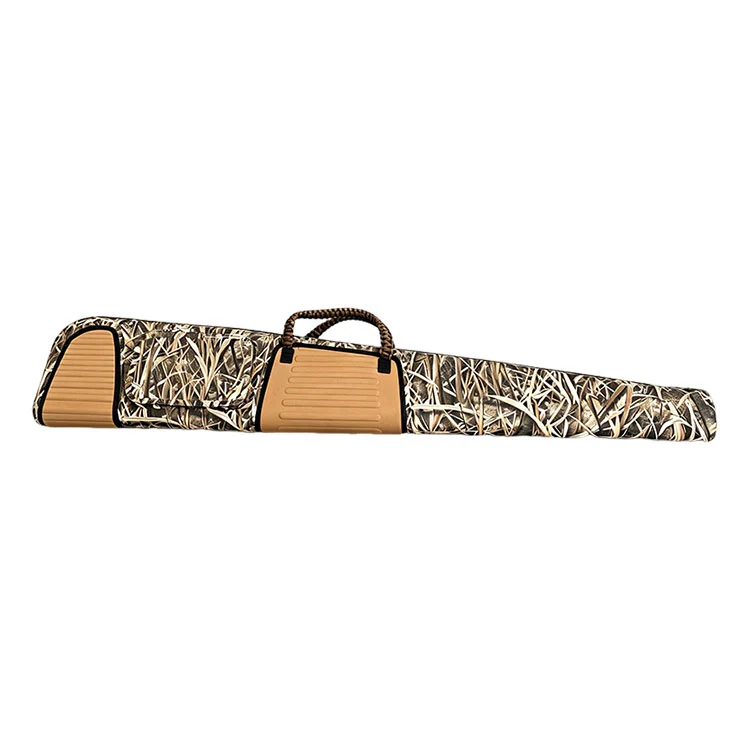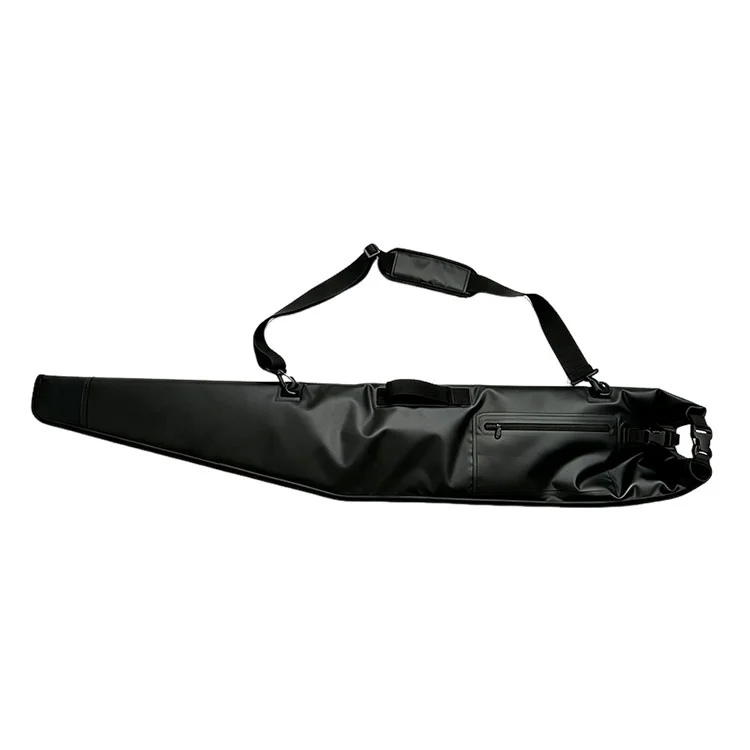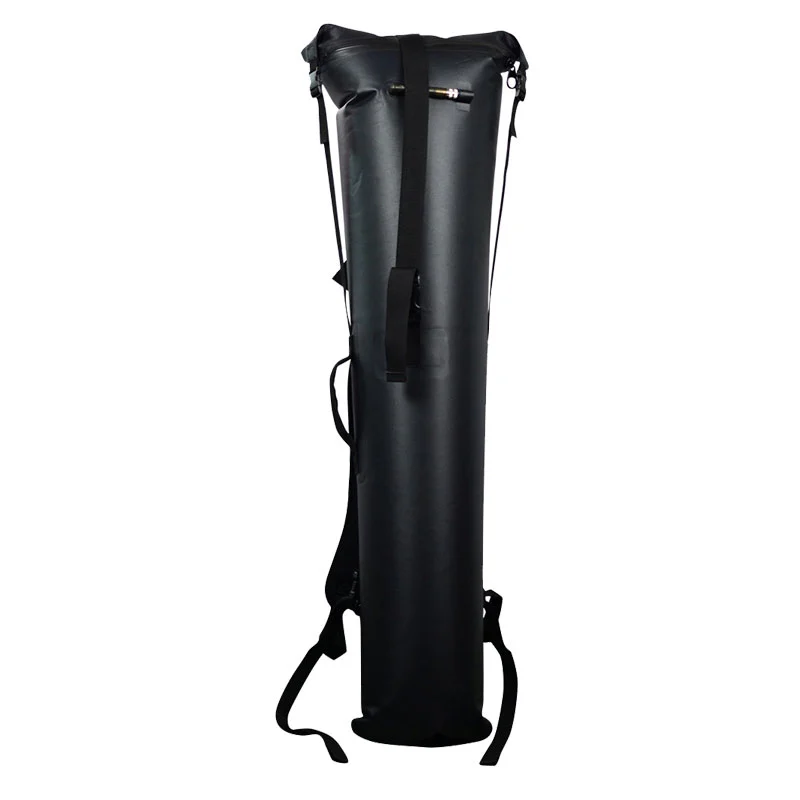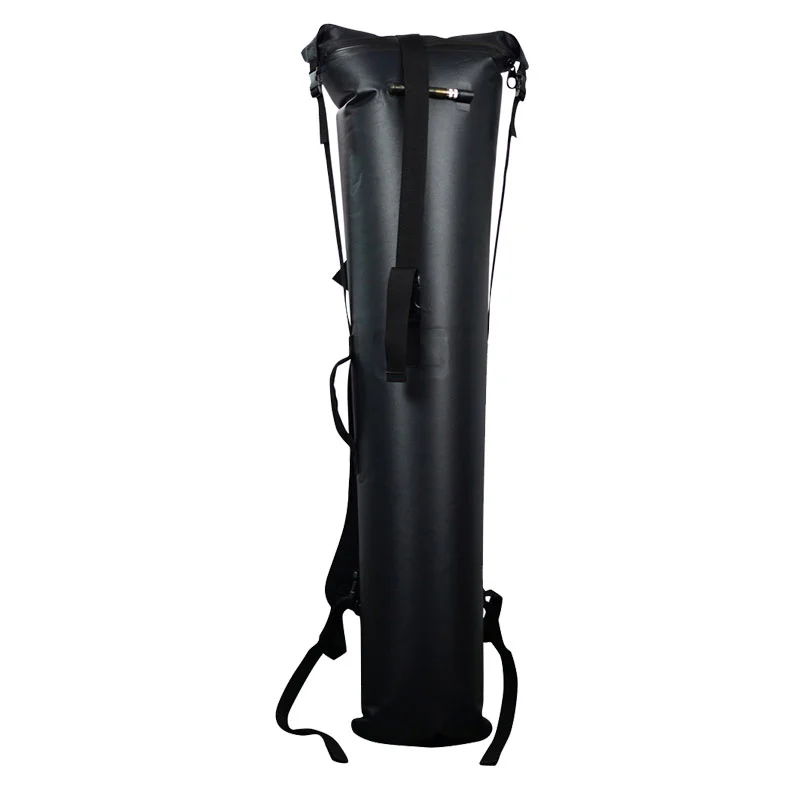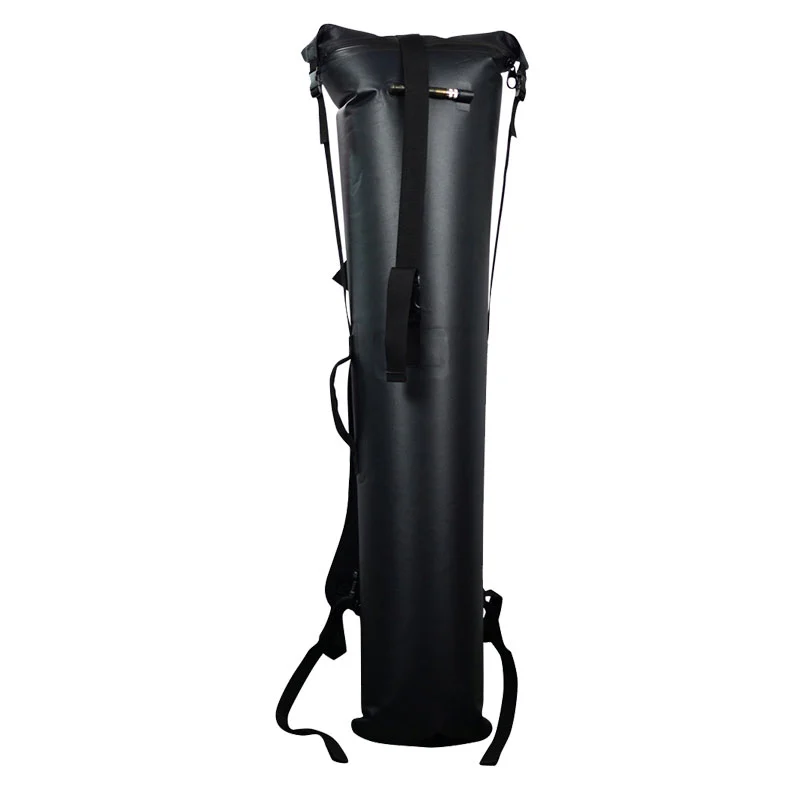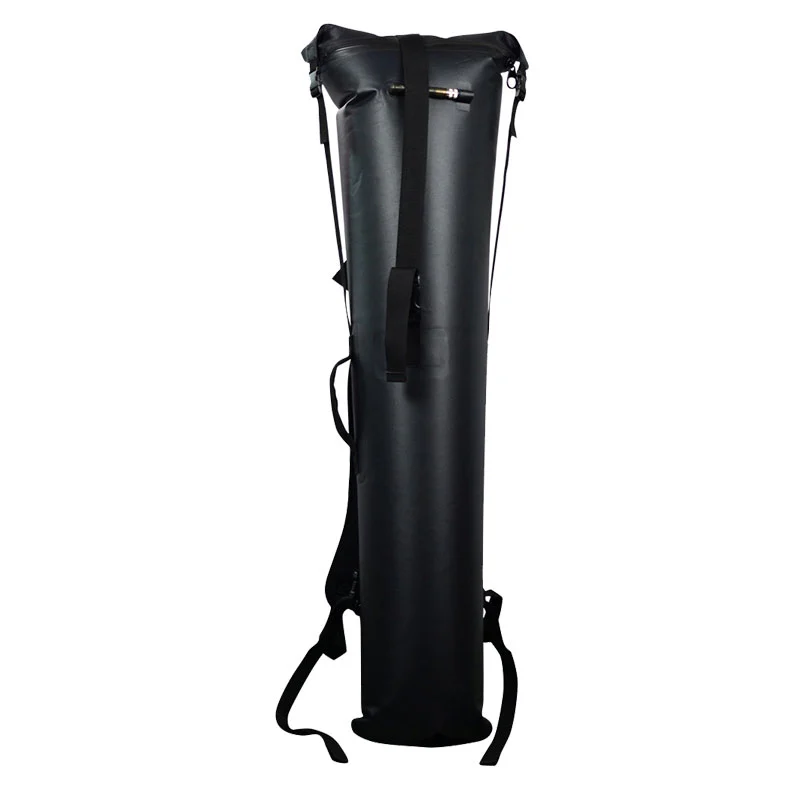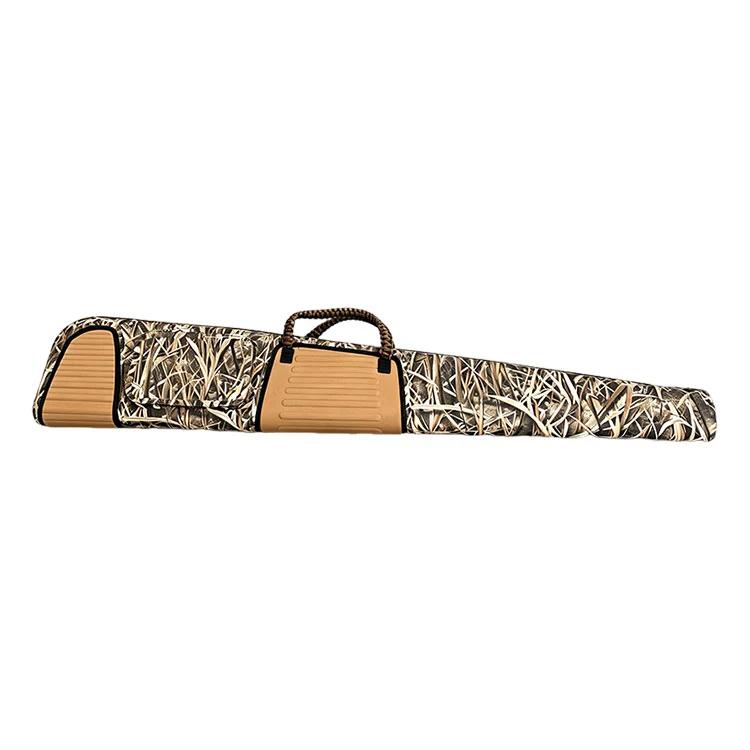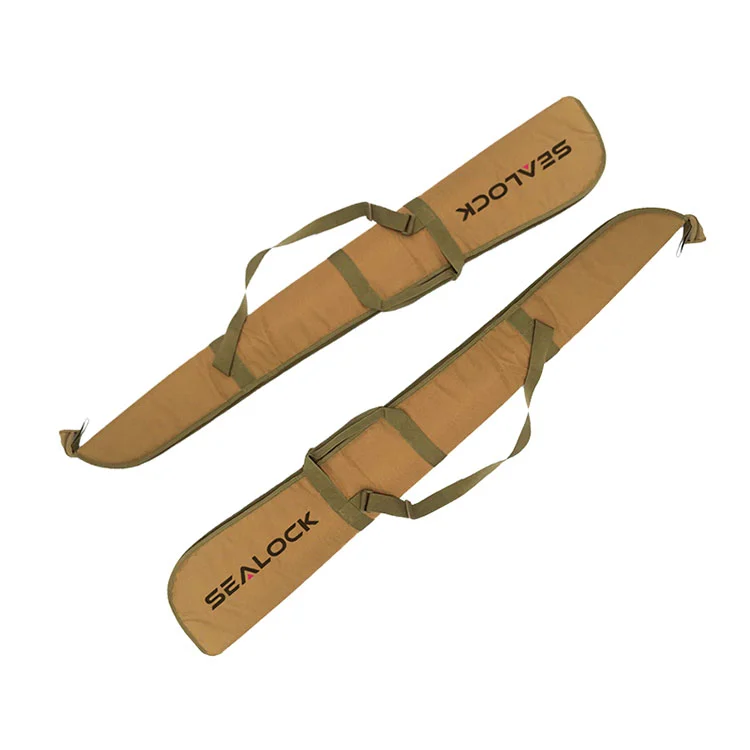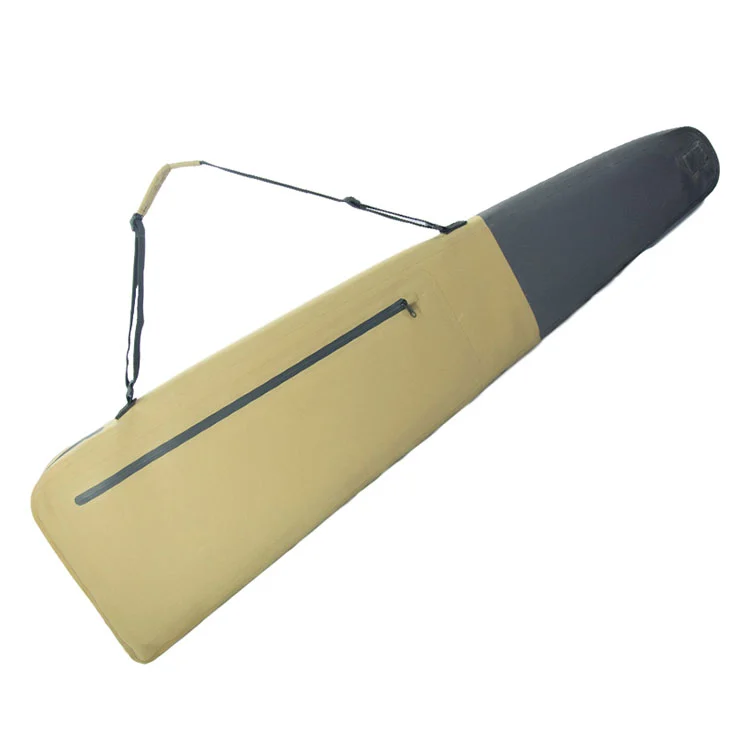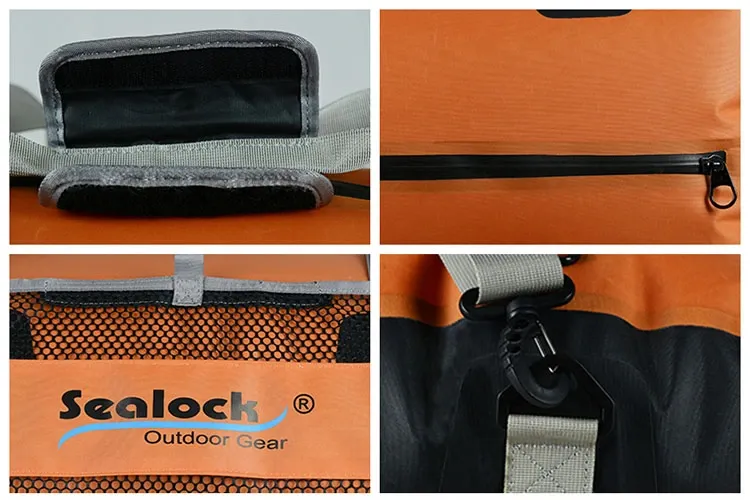
The SL-E899 Field Shotgun Slip is a soft gun case measuring 122 × 26 cm (48 × 10–11 in), quoted in three build weights: standard at approximately 0.85 kg, light at approximately 0.68 kg and minimum at approximately 0.55 kg. The standard build is 600D polyester Oxford with a water-resistant finish, 15 mm foam padding, a zippered accessory pocket, a 50 mm padded strap and a reinforced handle. Bar-tack reinforcement and bound internal edges are retained in every build. MOQ 300 pcs, samples in 7–10 days, production in 30–45 days.
Build weight is a configurable specification rather than a fixed figure. Outer fabric (600D or 420D), padding thickness (15 mm or 10 mm), accessory pocket, strap width (50 mm or 38 mm) and carry handle are each specified per programme, and each carries a stated weight value. The tables below give the weight saved and the property given up for every option.
Weight values per option: 600D to 420D outer fabric saves approximately 90 g; padding from 15 mm to 10 mm saves approximately 80 g; deleting the accessory pocket saves approximately 45 g; strap from 50 mm to 38 mm saves approximately 35 g; deleting the carry handle saves approximately 30 g; a thinner lining saves approximately 25 g.
The Weight Budget
These are the levers available on a 0.85 kg base, in the order buyers usually reach for them.
Change
Weight Saved
What Is Given Up
600D to 420D outer fabric
approx. 90 g
Abrasion resistance against brush and vehicle beds
Padding 15 mm to 10 mm
approx. 80 g
Impact absorption at knock points
Remove the accessory pocket
approx. 45 g
Onboard storage for tools and cleaning kit
Strap 50 mm to 38 mm
approx. 35 g
Roughly 30% higher pressure on the shoulder
Remove the carry handle
approx. 30 g
Balanced hand carry when loading and unloading
Thinner lining
approx. 25 g
Finish protection against rubbing
Taking all six brings the slip to about 0.55 kg — a 36% reduction. Few programmes should take all six, and the order in which they are taken matters more than the total.
Which Trades Are Worth Making
Usually worth it
Removing the accessory pocket is the cleanest saving on this list, because it costs a feature rather than a protective property. Buyers whose customers carry a separate bag lose nothing at all, and it takes 45 g out without touching abrasion, impact, or finish protection.
Worth it in the right market
Dropping padding from 15 mm to 10 mm suits open ground and light guns where knocks are rare. It is the wrong call for rough shooting over stone walls and vehicle transport on farm tracks, where the padding is doing real work.
Rarely worth it
Narrowing the strap saves 35 g and raises shoulder pressure by around 30%, which is a poor exchange on a product carried over distance — the weight comes off the scale and lands on the shoulder. Removing the handle saves 30 g and makes every load and unload harder.
Depends entirely on terrain
Moving from 600D to 420D is the largest single saving and the one with the most variable consequence. In open grass and stubble it costs little; through blackthorn, bramble, and stone it shortens service life measurably.
Three Builds We Quote
Build
Approximate Weight
Specification
Suits
Standard
approx. 0.85 kg
600D, 15 mm padding, pocket, 50 mm strap, handle
Mixed terrain and general field use
Light
approx. 0.68 kg
600D, 10 mm padding, no pocket, 50 mm strap, handle
Open ground, walked days, lighter guns
Minimum
approx. 0.55 kg
420D, 10 mm padding, no pocket, 38 mm strap, no handle
Weight-critical programmes accepting the trade
Most retail programmes settle on the standard or light build. The minimum build is quoted where a brand is competing explicitly on weight and is prepared to state the compromises in its own listing.
What We Do Not Recommend Removing
Two things stay in every build:bar-tack reinforcement at strap anchors and zip terminations, and bound internal edges. Neither carries meaningful weight — together they are a few grams — and both are what stop a light slip failing early at the points that take repeated load. A slip that saves 30 g by skipping reinforcement is not a lighter product; it is a shorter-lived one.
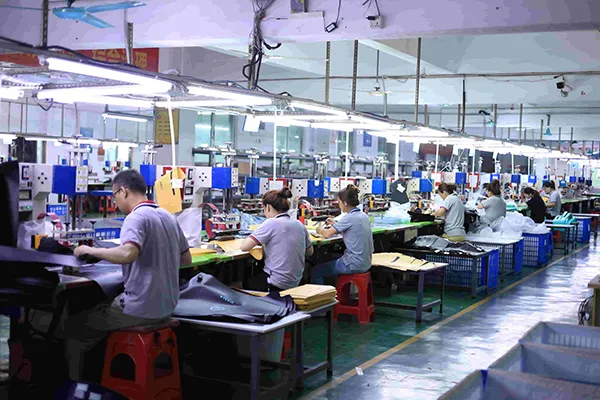
1. Incoming inspection of fabric, foam, lining, webbing, and zip
2. Precision cutting of shell, foam, and lining to the specified build
3. Layer assembly to the configured padding thickness
4. Full-length zip installation into a reinforced bound seam
5. Bar-tack reinforcement at anchors and terminations — retained in every build
6. Strap, handle, and pocket attachment per configuration
7. Edge binding and seam reinforcement
8. Weight verification against the quoted build
9. Final inspection and export packing
Checks Before Shipment
Check
Method
Frequency
Incoming material
Visual and dimensional
Every batch
Finished weight
Weighed against the quoted build figure
Sampling
Padding thickness
Measured against specification
Sampling
Bar-tack reinforcement
Visual at anchors and terminations
100%
Zip function
Full-length operation
100%
Strap pull
Loaded pull test
Sampling
Packaging
Carton verification
100%
Build Trials
Trial
Method
Outcome
Weight verification
Each build weighed at sample stage
Figures confirmed against quotation
Abrasion, 600D against 420D
Both fabrics run against brush and stone
600D held longer; 420D showed wear sooner
Padding comparison
Knock test at 15 mm and 10 mm
15 mm absorbed a heavier knock; 10 mm adequate for light contact
Strap pressure
50 mm padded against 38 mm, same load
Narrow strap raised shoulder pressure noticeably
Anchor load
Loaded cycles on the minimum build
Bar-tacked anchors held; reinforcement retained in all builds
Water-resistance
Surface spray on both fabrics
Both shed surface water; interior dry
The construction is stitched with a standard coil zip and is water-resistant rather than waterproof; it is not immersion tested.
Field Types It Suits
Walked-up and rough shooting over mixed ground; upland bird hunting across stubble and grass; farm and estate use with frequent vehicle transitions; long walk-in access where every gram is carried; hill and moor shooting on open terrain; and general field carry where a hard case is more than the day requires.
Recent Work
Scotland — estate and hill shooting supplier
The supplier asked for the lightest slip we could build, then reconsidered after seeing the trade table. Hill ground meant heather, stone, and repeated vehicle loading, so 420D would have shortened service life for a 90 g saving. They took the light build instead — 600D retained, padding at 10 mm, pocket deleted — landing at about 0.68 kg. 450 pcs, 40 days.
Central Europe — walked-up game distributor
Their customers carry a separate cartridge bag, so the accessory pocket on the slip was never used. Deleting it took 45 g out without touching any protective property, which was the whole saving they needed to hit their target weight. 600 pcs, 39 days.
United States — ultralight hunting brand
The brand competes explicitly on weight and was prepared to state the compromises in its own listing. We quoted the minimum build at about 0.55 kg with 420D, 10 mm padding, no pocket, 38 mm strap, and no handle, while retaining bar-tack reinforcement and bound edges throughout. 350 pcs, 41 days.
What Buyers Told Us
“You showed us what each saving cost before we chose. We took less weight off than we planned and were right to.”
— Buyer, Estate Shooting Supplier
“Deleting the pocket was free weight for us. Our customers never used it, and nothing protective came out.”
— Product Manager, Walked-Up Game Distributor
“We wanted the lightest possible and you still refused to remove the bar-tacking. Two seasons on, that was the right call.”
— Founder, Ultralight Hunting Brand
Buyer Questions
1. How light can this Field Shotgun Slip be made?
About 0.55 kg from a 0.85 kg base, a 36% reduction, by moving to 420D fabric, 10 mm padding, no accessory pocket, a 38 mm strap, and no handle. Few programmes should take all five, and the order they are taken in matters more than the total.
2. Which saving should we take first?
Deleting the accessory pocket. It saves around 45 g and costs a feature rather than a protective property, so buyers whose customers carry a separate bag lose nothing.
3. Is 420D fabric a bad choice?
Not inherently — it is the largest single saving at around 90 g. In open grass and stubble it costs little. Through blackthorn, bramble, and stone it shortens service life measurably, so the decision follows the terrain.
4. Should we narrow the strap to save weight?
We advise against it. It saves around 35 g and raises shoulder pressure by roughly 30%, so on a product carried over distance the weight comes off the scale and lands on the shoulder.
5. What is the difference between 15 mm and 10 mm padding?
In knock testing, 15 mm absorbed a heavier impact while 10 mm was adequate for light contact. The 10 mm build suits open ground and lighter guns; 15 mm is better for rough shooting over stone and farm-track transport.
6. Is there anything you will not remove?
Bar-tack reinforcement at strap anchors and zip terminations, and bound internal edges. Together they weigh a few grams and are what stop a light slip failing early at the points taking repeated load.
7. Which build do most retail programmes choose?
The standard build at about 0.85 kg or the light build at about 0.68 kg. The minimum build is quoted where a brand competes explicitly on weight and will state the compromises in its own listing.
8. Will you confirm the weight of the build we order?
Yes. Finished weight is checked against the quoted build figure at sampling and by sampling in production.
9. Does a lighter build still shed rain?
Yes. Both 600D and 420D carry the water-resistant finish and shed surface water in testing. It remains water-resistant rather than waterproof in every build.
10. Can we run two builds in one order?
Yes. Buyers commonly run a standard build for general retail and a light build for a walking-focused line from the same pattern.
11. Does removing the handle affect anything besides carrying?
It removes the balanced lift point used when loading a vehicle or passing the slip to someone. Customers who load and unload frequently notice it more than customers who carry continuously.
12. What are the commercial terms?
MOQ 300 pcs, samples in 7–10 days, production in 30–45 days, quoted EXW, FOB, or CIF, with development covering fabric weight, padding, pocket, strap, handle, colourway, and packaging.
We use cookies to offer you a better browsing experience, analyze site traffic and personalize content. By using this site, you agree to our use of cookies. Privacy Policy